Every store in a multi-site retail chain produces cash. Almost none of them were designed to manage it. Cash sits in drawers until a manager carries it to a bank counter, a deposit machine, or the back of a car bound for a regional office — and between the till and the deposit, the money is exposed to error, theft and pure opportunity cost. Multi-site cash consolidation is the discipline of moving that cash deliberately, in fewer and larger movements, under controls that survive an audit. This guide walks through where retail cash actually goes today, what holding it locally really costs, and the three consolidation models operators choose between.

Where Store Cash Goes Today
The European Central Bank’s 2024 survey of companies’ cash use offers the clearest public picture of how businesses deposit cash. Among companies that use cash, deposit machines ranked first as a deposit channel (56% of respondents), followed by bank counters (49%), cash-in-transit providers (17%) and night safes (14%). The same survey found that 66% of companies carry out their cash operations without automation, and that a majority of the non-automated group have no plans to automate. In other words, most business cash still moves through the least controlled channel available — very often a manager driving cash to a branch themselves.
| Deposit channel | Share of companies using it (ECB 2024 survey) |
|---|---|
| Deposit machine (own or bank) | 56% |
| Bank counter | 49% |
| Cash-in-transit company | 17% |
| Night safe | 14% |
Source: ECB survey on companies’ cash use, 2024. Respondents could use multiple channels, so shares sum to more than 100%.
The numbers describe Europe, but the pattern travels well: deposit machines and manual branch trips dominate, professional CIT is a minority channel, and automation lags. For a chain with dozens or hundreds of sites, that mix is expensive in ways that rarely appear on any line item.
What Cash in a Store Actually Costs
Cash sitting in a store safe is inventory that earns nothing and consumes staff time. The scale is easy to underestimate. GardaWorld’s cash-operations analysis puts the opportunity cost of idle cash at roughly $700 per day for every $100 million held — more than $250,000 per year in forgone earnings on money that is doing nothing. The same analysis credits statistical cash forecasting with reducing overall cash levels by 20–40% in operations that adopt it. For a single store the numbers are smaller; multiplied across a chain, idle cash becomes one of the larger unexamined costs in retail finance.
Then there is the error cost. Manual recounts at the end of long shifts, hand-written deposit slips, safe counts done by whoever closes — each step is a variance generator. Chains that investigate variances seriously usually find that a minority of sites produce most of them, and that the mechanism is procedural, not dishonest. Consolidation reduces the number of times cash is touched, which mechanically reduces the number of chances to miscount it. The step-by-step handling of a CIT handover procedure is one formalization of this principle for the professional transport leg; the same discipline applies to the informal legs.
The Three Consolidation Models
In practice, multi-site operators choose among three models, and most chains end up running a hybrid of two of them.
Model 1: Local deposit machines, no consolidation. Each store deposits directly into a bank-owned or bank-adjacent deposit machine. Cash leaves the store daily, credit is provisional, and the chain never consolidates inventory. This model minimizes on-site cash but multiplies deposits, fees and site-level banking relationships.
Model 2: CIT collection to a central point. A cash-in-transit provider collects sealed deposits from stores on a schedule and delivers them to a vault or the chain’s own cash center. The chain gains a single consolidated position, negotiable wholesale fees, and one custody trail. The cost is the CIT contract and the discipline the sealed-bag regime demands — sealed handovers with witnessed counts are what make the model defensible when a bag goes missing.
Model 3: Smart safes in store, CIT pickup, provisional credit. The store feeds cash into a smart safe that counts and validates at the moment of deposit; the CIT provider empties the cassettes; the chain receives provisional credit based on the safe’s audit record, often before the cash is even transported. This is the model most frequently deployed by chains that combine high cash volumes with thin back-office staffing. A detailed review of smart safe contracts appears in our earlier piece on smart safe and deposit machine agreements.

Cash Quality Matters When It Arrives
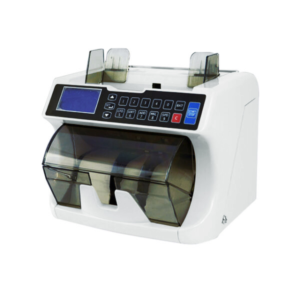
Consolidation concentrates cash, and concentrated cash gets inspected. Deposits that reach a central bank or vault are checked against fitness and authentication standards, and rejected items cost re-handling on both ends. The US Federal Reserve publishes denomination-specific fitness guidelines — thickness thresholds, hole and tear limits, ink wear criteria — and the Eurosystem’s banknote recycling framework defines machine-based fitness classes for processed cash. Chains that count and fitness-check before dispatch, rather than after arrival, discover that their deposit rejections are not bad luck but specific stores feeding specific machines. A mid-range banknote counter with fitness sensors at the consolidation hub, or at the largest stores, pays for itself in avoided re-handling alone.
Forecasting the Hub: How Much Cash Should Circulate
Once cash is consolidated, the chain can finally manage it as inventory. The principle is the same as any inventory question: hold enough to cover replenishment lead time plus variability, and not a dollar more. Industry analysis (the GardaWorld figures above) suggests mature forecasting programs cut cash holdings by a fifth or more. Practically, this means the hub knows each store’s deposit cadence, the CIT schedule, and the bank’s credit availability windows, and adjusts collection frequency by seasonality rather than running one fixed schedule all year. Chains that only negotiate the CIT rate and ignore the schedule design typically leave more money on the table than the rate negotiation saved. Our earlier treatment of branch cash forecasting walks through the inventory logic in detail.
Store-Level Discipline: Where Consolidations Fail
The hub can only be as trustworthy as the bags coming into it, and most failed consolidations fail at the store edge rather than in transport. Three controls carry most of the weight. First, count before seal: the store counts its deposit on a machine — a counter with counterfeit detection is sufficient at this tier, and the reasons coin and note batches produce surprising variances are worth understanding before blaming staff — and the count record travels with the bag, not in the bag. Second, witness the seal: two people present at bagging, both signing the manifest, converts a missing bag from an unanswerable question into a bounded custody investigation. Third, log the handover: every transfer of custody, store-to-guard and guard-to-hub, gets a time, a name and a signature. None of this is sophisticated, and none of it works when done from memory.
Variance patterns deserve a specific note. Chains that consolidate usually see, within a quarter, that a small number of sites produce the majority of discrepancies — typically a mix of end-of-shift counting habits, one damaged machine, and process shortcuts on busy days. The consolidation structure makes those patterns visible for the first time, because every site’s counts now flow into one system. Treat that visibility as a benefit: the sites with chronic small variances are not usually dishonest, they are unprocess-controlled, and the fix is procedural rather than punitive. The mechanics of running such an investigation are laid out in our guide to cash variance investigation.
Suppliers such as Cummins Allison sell into both ends of this pipeline — store-level counters and hub-level sorters — which is a reminder that consolidation is an equipment decision as much as a logistics one. The machines at each tier differ in what they must do: store tier emphasizes fast, verified deposits; hub tier emphasizes fitness sorting, denomination processing and bundling for onward delivery. For typical hub throughput requirements, machines in the DB550 class — 600 to 1,600 notes per minute with selectable detection modules — cover the middle ground between a store counter and a full multi-pocket sorter, which is where most regional hubs actually operate.
Choosing the Right Model: A Comparison
| Dimension | Local deposit machines only | CIT to central hub | Smart safes + CIT pickup |
|---|---|---|---|
| Cash exposure in store | Low (daily removal) | Medium (until pickup) | Low (validated at deposit) |
| Credit timing | Per deposit, provisional | After hub processing | Provisional at deposit, often same or next day |
| Records and audit trail | Machine + bank slip per store | Sealed-bag custody chain | Safe audit file per note fed |
| Fixed costs | Per-site machine/banking fees | CIT contract + hub processing | Smart safe contract (often bundled fees) |
| Staff burden per store | Daily deposit runs | Bagging and handover | Feeding the safe only |
| Works best for | Small chains, dense bank coverage | Chains with a regional footprint and one treasury | High-cash-volume chains with thin back office |
The comparison is directional by design: fee structures vary by market and by contract, and no table should substitute for pricing your own footprint. What the table does show is the structural trade-off — each model moves control either toward the store (more local autonomy, more local records) or toward the hub (one treasury position, one custody trail). Chains rarely regret consolidating; they regret consolidating without the handover discipline and forecasting that make the hub position trustworthy.