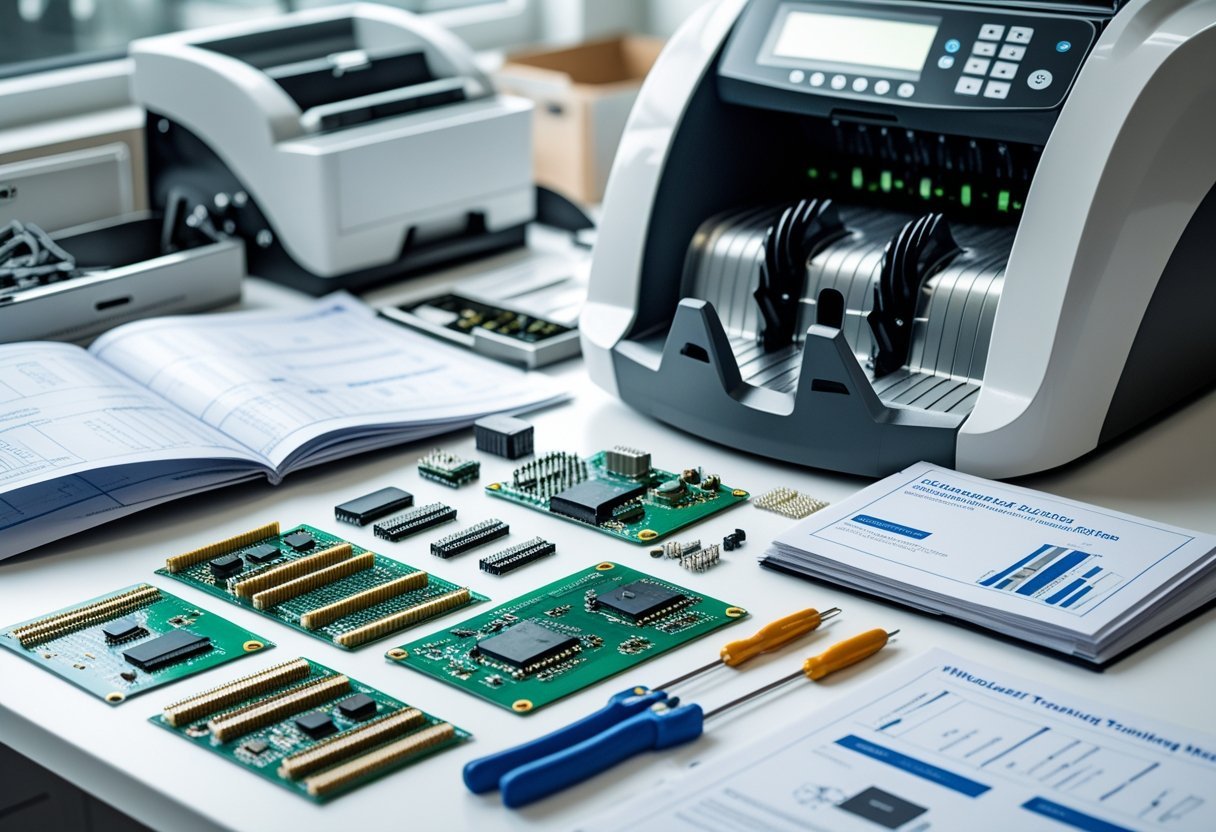
Walk into any bank equipment tender and you will find both machines on the same price list: the teller cash recycler, several times the cost, and the banknote counter, a fraction of it. Procurement teams routinely treat the recycler as “the premium option” and the counter as “the budget option”, which misreads both products. They solve different problems, and choosing between them is a workflow decision before it is a purchase decision.
This article compares the two on their actual operating logic, using the Eurosystem’s machine classification for the regulatory picture and published survey data on cash automation to size the market context. Where numbers are modelled rather than measured, the assumptions are stated openly.
Two machines, two jobs
A banknote counter is a throughput device. It counts, optionally classifies by denomination, optionally authenticates, and stacks. Notes pass through it once, in one direction, into a stacker. The operator decides what happens next: bag it, seal it, hand it to the CIT crew, feed it again for batching.
A teller cash recycler is a storage device with counting built in. It takes notes in, authenticates and usually fitness-checks them, stores them in cassettes, and dispenses from that same stock for the next customer who wants cash out. Deposits at one window become withdrawals at another. The machine holds a live cash float instead of producing a finished bundle.
That single difference — recycling the notes it receives — drives everything else: the certification regime it falls under, the security requirements of the room it sits in, the service contract it needs, and the arithmetic that decides whether it pays for itself.
What the European rulebook says about each machine
The Eurosystem’s classification of banknote handling machines is the clearest public framework for understanding the functional divide, because eligibility for processing euro cash depends on the class a machine falls into and whether it has passed the relevant test. The classes, from the ECB’s published test procedures (ECB, Procedures for testing banknote handling machine types), break down as in Table 1.
| Sınıf | Operated by | What it does | Recycles deposits? |
|---|---|---|---|
| CRM — cash recycling machine | Customer | Accepts and checks notes, dispenses notes deposited by other customers | Evet |
| CCM — combined cash-in machine | Customer | Accepts and checks deposits; dispenses separately loaded stock | HAYIR |
| CIM — cash-in machine | Customer | Accepts and checks deposits only | HAYIR |
| COM — cash-out machine | Customer | Checks and dispenses notes | HAYIR |
| BPM — banknote processing machine | Staff | Checks authenticity and fitness of notes | HAYIR |
| BAM — banknote authentication machine | Staff | Authenticity check only | HAYIR |
| TARM — teller assistant recycling machine | Staff | Stores notes, allows cash handlers to credit or debit customer accounts, checks authenticity and fitness | Evet |
| TAM — teller assistant machine | Staff | Stores notes and supports crediting/debiting, authenticity check only | HAYIR |
The counter you know from the back office belongs in the BPM/BAM family. The teller recycler is the TARM class — and for customer-facing deployments, the CRM. The regulatory consequence matters: notes that will be recirculated to the public must be checked by machine types that have passed the Eurosystem’s tests, including fitness checking for recycled notes. A machine that stores and re-dispenses carries a heavier authentication and fitness burden than a machine that counts once for deposit.
Outside the euro area the specific rules differ, but the underlying logic is common: the moment a machine re-issues notes that customers deposited, regulators demand authentication and fitness standards appropriate to customer-operated equipment, which are stricter than what a back-office counter needs to meet.
The workflow difference in practice
Count the steps a note passes through in each configuration and the operating cost difference starts to explain itself. (For how these devices sit inside the wider room layout, see our article on cash office design and throughput planning.)
With a counter: the teller receives cash, keys the expected amount, feeds the stack, reads the result, resolves any discrepancy manually, replaces the drawer roll, and — at end of shift — counts the drawer again. The deposit bundle then travels to the vault or the CIT crew. Every note is touched and counted multiple times by humans and machines across its branch life.
With a recycler: the teller feeds the stack once; the machine authenticates, values and stores it. When the next customer withdraws, the machine dispenses from that stock, already checked. End-of-day reconciliation happens against the machine’s own records instead of a manually re-counted drawer. The note’s handling count drops sharply, and so does the number of human touchpoints where errors and disputes originate.
The counter’s genuine advantages survive this comparison, though. It is a fraction of the price, it is portable, it needs no floor space allocation beyond a desk, it works with any currency you have a profile for, and when it fails it does not take the branch’s ability to pay out cash down with it — a mid-range unit such as the DB550 weighs about six kilograms and sits on any desk. A recycler outage is a branch operations event; a counter outage is a desk drawer and a second machine.

What the automation data says
Before running any break-even math, it is worth knowing how far along the market actually is, because recycler sales pitches often assume an urgency that survey data does not support. The ECB’s 2024 survey of cash use by companies across the euro area (7,675 respondents across all 20 euro countries) gives the baseline, summarised in Table 2.
| Indicator | Result |
|---|---|
| Companies accepting cash | 88% (down from 96% in 2021) |
| Cash-accepting companies expecting to continue for five years | 94% |
| Companies regularly depositing cash | 70% |
| Most common deposit channel — cash-in machines | 56% |
| Deposit via bank counter | 49% |
| Deposit via CIT providers | 17% |
| Companies that have NOT automated their cash operations | 66% |
| Of automated companies: installed smart cash tills | 20% |
| Of automated companies: cash-accepting checkout terminals | 10% |
| Non-automated companies with no plans to automate | 85% |
Kaynak: ECB, Euro Bölgesinde Şirketlerin 2024'te Nakit Kullanımı.
Read plainly, two-thirds of the companies that handle cash daily have not automated any of it, and most of those have no intention of starting. That is not an argument against recyclers; it is a warning about where the business case actually lives. Automation investments pay where volumes concentrate — banks, CIT processors, large retail — not where a survey majority sits. If your volume profile looks like the median surveyed retailer, the honest recommendation is usually a good counter and a disciplined process, not a recycler waiting for volume that will not arrive.
The staffing math: what you are really buying back
The recycler’s economic argument is time. To model it, you need a wage and a realistic time saving. US Bureau of Labor Statistics OEWS data for May 2024 puts the median bank teller wage at $17.62 per hour, about $36,640 per year (BLS, Occupational Employment and Wage Statistics, May 2024). European wage levels vary by country; the method below works with any local figure.
A worked example, clearly labelled as a model with stated assumptions:
- Branch cash transactions: 250 per day, of which 150 are deposits or cash payments averaging a manual count of 90 seconds that a recycler reduces to 20 seconds of feed time.
- End-of-day drawer reconciliation: 25 minutes per teller per day, reduced to roughly 8 minutes against machine records.
- Two tellers on cash duty, 250 business days per year, loaded labour cost $22 per hour (wage plus employer costs).
Counting time saved: 150 × 70 seconds × 250 days ≈ 729 hours per year. Reconciliation time saved: 2 tellers × 17 minutes × 250 days ≈ 142 hours per year. Total ≈ 871 hours, or about $19,200 per year at $22 per hour. Against a loaded recycler cost of — this is where the model stops being universal — purchase price plus service contract plus consumables, most published deployments in dense-transaction branches recover the investment in two to five years. But look at the sensitivity: a branch doing 60 cash transactions a day saves roughly a third of that figure, and the payback stretches past the machine’s useful life. The transaction count is the variable that decides everything, which is why the vendor should be asked for transaction counts from comparable branches rather than aggregate claims.
The model also omits two effects that only sometimes cut in the recycler’s favour: reduced cash insurance premiums (insurers price vault-in-machine storage differently) and lower CIT frequency, since the float cycles in-house. Both depend on local arrangements, so treat them as upside, not baseline.
Where the counter still wins
There are deployments where recommending a recycler would be malpractice:
- Low and uneven volume. Under roughly 100 cash transactions per branch per day, the time saved rarely covers the recycler’s service contract alone.
- Multi-currency back offices. A counter switching between currency profiles on demand handles a mixed-currency desk more flexibly than a recycler configured for a float of one or two currencies.
- Cash that leaves immediately. If most deposits are bundled for CIT pickup without re-issue — the pattern in many small retail and wholesale operations — the recycling loop never closes, and you paid for storage you do not use. The deposit-side workflow is covered in our article on CIT handover procedures.
- Tight budgets with standardisation needs. Five counters can be bought, swapped and serviced for the cost of one recycler’s first year of support, and a spare counter on a shelf is a form of resilience a recycler cannot offer.
For these deployments, a heavy-duty counting machine with value counting and authentication — the class typified by units like the DB780A, rated for 600 to 1,600 notes per minute depending on mode — delivers most of the operational benefit at a very different cost point. The five-year cost structure of that choice is covered in our earlier cost breakdown.
Where the recycler earns its keep
Conversely, the recycler is the right answer when these conditions hold simultaneously:
- Sustained two-way volume. Deposits and withdrawals both run high all day, so the stored float actually cycles. A recycler that only accumulates is an expensive safe.
- Single dominant currency. The float is one currency, which keeps the profile problem simple and authentication consistent.
- Teller labour is expensive or scarce. In markets where teller turnover is chronic, the machine holds the procedural knowledge: it counts, it balances, it never calls in sick.
- The room can support it. Power, floor space, network integration with the core banking system, and physical security appropriate to a device holding a live float.
- Regulatory pathway is clear. For euro operations, the machine type must be on the list of successfully tested machines; elsewhere the equivalent approval must exist before purchase, not after.
Larger branches often run both devices: recyclers at the teller line for the customer-facing flow, counters in the back office for vault preparation, CIT bundling and the mixed-currency exceptions. The comparison is not a bracket to pick one from; it is a portfolio decision.
Hidden costs to price before signing
Whichever side you land on, four cost items routinely surprise buyers:
- Service contracts. Recyclers are cassette-and-vault machines; downtime costs branch capacity, so response-time SLAs are priced accordingly. Get the multi-year service quote, not the first-year promotional one.
- Software integration. A recycler that does not talk to the core banking system delivers half its benefit. Integration work is a real budget line, often larger than expected.
- Sarf malzemeleri ve aşınan parçalar. Feed rollers, belts and sensor windows wear faster on recyclers because deposit condition is uncontrolled. Ask for the wear-parts price list and the expected replacement intervals.
- Security upgrades. A device holding a float may trigger requirements for the room it sits in — reinforced furniture, alarm integration, CCTV coverage. Price the room, not just the machine.
A five-question decision test
- How many cash transactions per day, split deposits versus withdrawals? (Below ~100 total, start with counters.)
- What share of deposits is re-issued in-branch within a week? (Low share, low recycling benefit.)
- How many currencies must the device handle daily? (Two or more, profile depth beats float convenience.)
- What does a teller-hour actually cost, loaded, in your market? (Feed it into the model, not the list price.)
- Is the machine type approved for recirculation in your jurisdiction? (For euro: check the ECB tested-machines list first.)
Sıkça sorulan sorular
Can a banknote counter dispense cash?
No. A counter counts and stacks in one direction; it has no cassette storage or dispensing mechanism. Dispensing requires a recycler or a dedicated dispensing module.
Do recyclers count faster than counters?
Generally not. Counters remain the throughput champions for pure batch counting — heavy-duty units run 1,500+ notes per minute in count-only mode. Recyclers trade raw speed for storage, authentication depth and dispensing.
Is fitness checking mandatory for recycled notes?
In the euro area, yes — notes recirculated to the public must be checked for authenticity and fitness by machine types that have passed the Eurosystem tests. Other jurisdictions apply similar principles with local rules.
Can one branch justify both machines?
Often, yes: a recycler at the teller line plus one or two back-office counters for vault and CIT preparation is a common and defensible configuration in high-volume branches.
What happens when the recycler’s float runs out on a busy day?
Branches manage float levels against forecast demand; when the cassette is short, the teller tops it up from vault stock by feeding the machine, which re-authenticates the notes on the way in. Poor float forecasting shows up as teller queue times, so monitor it.