Cheque volumes keep falling, and cheque value does not. That combination is what makes equipment decisions in this area awkward: the average cheque is now a large, deliberate payment, issued by a business rather than a consumer, and far more likely to be examined by a fraud team than a card transaction.
The Federal Reserve’s payments data puts the scale in perspective. Americans wrote 9.2 billion cheques in 2024, worth USD 24.45 trillion, down from 42.6 billion cheques in 2000, according to the Federal Reserve Payments Study. The count fell by almost 80 per cent; the value carried by the remaining instruments is roughly 60 per cent of what it was at the turn of the century, and the average cheque is now above USD 2,600.
For anyone specifying cheque issuing equipment, the practical question is not whether cheques will disappear. It is which of two devices you need, because they do different jobs and are frequently confused in procurement documents.

Two jobs, often conflated
A cheque carries two kinds of information, and they are produced by different technologies.
The first is the machine-readable line along the bottom: the routing or sort code, the account number, the cheque number, sometimes the amount. These characters are printed in magnetic ink in a defined font, which is what allows a reader-sorter to process tens of thousands of items an hour. This is MICR encoding, and it requires either pre-encoded cheque stock or a printer and toner that meet the MICR standard.
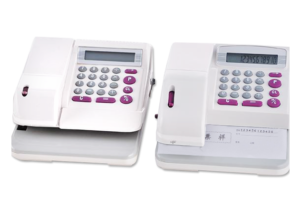
The second is the human-readable and fraud-resistant content: payee name, date, amount in figures and words, signature. This is where an impact cheque writer earns its place. It prints through a ribbon with security ink, often embosses the amount so it can be felt, and keeps a sequential record of what it issued.
Most business cheque stock arrives with the MICR line already printed by the bank or the forms supplier. The writer fills in the variable fields. A bank that issues its own drafts, or a payroll bureau producing high volumes, may instead encode in-house with a MICR laser printer on blank security stock. Both routes are legitimate; they carry different compliance burdens and different cost structures.
What MICR actually requires
MICR is unforgiving because the reading head measures a magnetic waveform, not a picture. Two cheques that look identical to the eye can produce different signals if the ink film weight differs, and a character that reads perfectly in a scanner can fail on a reader-sorter.
The core parameters are stable across markets and are worth knowing when you assess a supplier’s claims.
| Parameter | Requirement | Why it matters |
|---|---|---|
| Character set | E-13B: digits 0–9 plus transit, amount, on-us and dash symbols | The waveform of each glyph must be distinguishable at speed |
| Character height | 0.117 in | Defines the read-head window and signal amplitude |
| Character pitch | 0.125 in, eight characters per inch | Field positions are measured from the document edge |
| Stroke width | 0.013 in nominal | Controls the peak amplitude of the magnetic signal |
| Clear band | 0.625 in from the bottom edge, kept free of other printing | Anything in the band interferes with reading |
| Signal strength | 50–200% of nominal per character | Below 50% the head cannot separate signal from noise; above 200% characters bleed into each other |
| Skew | Not more than 1.5 degrees, per character and across the line | Misalignment shifts the waveform timing |
Key E-13B print requirements. Source: NIST FIPS PUB 32-1, Print Specifications for Magnetic Ink Character Recognition; ANSI X9.100-20 as maintained by ASC X9.
The governing standards are ANSI X9.100-20 for print specifications and X9.100-160-1 for placement, both maintained by ASC X9, with ISO 1004 providing the international specification for the E-13B character set. In the United States, Regulation CC ties the definition of the MICR line to these standards, which is why a non-conforming line can create a returns problem rather than a cosmetic one.
Why MICR toner is not ordinary toner
MICR toner contains iron oxide, and the concentration and dispersion of that oxide determine the magnetic signal. Ordinary laser toner may look identical on the page and produce no readable signal at all. This is the single most common failure in in-house cheque printing: a well-intentioned office buys a laser printer, loads standard toner, and produces cheques that look correct and fail at the bank.
Three controls prevent it. Use toner certified for MICR, from a batch with documented oxide content. Verify the first article of every print run with a MICR tester that reports signal strength per character, not just a pass or fail. And record the tester output with the run, because when a cheque is disputed eighteen months later, the record is the only evidence of what was printed.
Where cheque writers fit
An impact cheque writer is a specialised device, and its value is in the constraints it imposes. It prints only in the fields it is designed for, in a font that is hard to alter, often with an embossed impression that survives photocopying. It cannot be repurposed to print a letter, which removes a category of internal fraud.
The feature set that matters in practice is narrower than the brochure suggests. Look for a clear numeric display that shows the amount before printing, so a keying error is caught before the cheque is spoiled. Look for a memory that records the number of cheques issued and the cumulative amount, which gives a reconciliation control without a separate logbook. Look for the ability to print several currency codes if the account handles more than one. And look for a repeat function, since recurring payments to the same payee are the common case in rent, payroll and supplier settlements.
Dongbo’s DB310 cheque writer is built around that set: a 14-digit display, embossed figures in security ink, automatic memory of issued cheques and totals, and support for five currency codes. The same platform is offered in DB310A and DB310B variants for buyers who need a different feature mix at a different price point.
What a writer does not do is encode the MICR line. If your cheques arrive without account and routing encoding, a writer alone will not make them processable, and the specification has to include either pre-encoded stock or a separate encoding step.
Where MICR laser printing fits
In-house MICR printing makes sense when volume is high, when cheque design changes often, or when the issuing institution must control the stock from blank paper onward. Banks issuing drafts, payroll bureaus, insurance companies paying claims and government disbursement offices are the classic cases.
The technical requirements are demanding in ways that are easy to underestimate. The printer must hold registration tightly enough to keep characters inside the clear band across a full run. Toner must be MICR-rated. Paper must be security stock with a background that does not interfere with the magnetic read. And the output must be verified, because a printer that drifts by two thousandths of an inch produces a run of cheques that fail without looking wrong.
The economics also differ. A MICR laser installation carries the cost of the printer, certified toner, security paper, a tester, and the labour of verification. Against that, the marginal cost per cheque is low, and the design flexibility is high. A cheque writer carries a low capital cost and near-zero consumable complexity, but each cheque is printed individually and the device cannot produce the MICR line.
The volume picture
Cheque volumes have fallen steadily for two decades, but the decline has been uneven across instrument types, and the remaining volume is concentrated in exactly the segments that issue cheques on equipment rather than by hand.
| Year | Cheques paid (billions) | Value (USD trillions) |
|---|---|---|
| 2015 | 17.0 | 26.05 |
| 2018 | 13.5 | 25.02 |
| 2021 | 11.0 | 26.37 |
| 2024 | 9.2 | 24.45 |
Cheque payments in the United States, selected years. Source: Federal Reserve Payments Study, 2024 estimates.
The value line is almost flat while the count falls. That is the signature of a payment method that has stopped being routine and become structural: business-to-business settlement, payroll in segments that never migrated, rent, insurance claims, and government disbursements to people who do not use bank transfers. Equipment decisions should be made against that profile, not against the headline decline.
Choosing between the three routes
There are three ways to produce a cheque, and the choice usually follows volume and control requirements rather than price alone.
| Route | Best fit | What it produces | Main compliance burden | Cost driver |
|---|---|---|---|---|
| Impact cheque writer | Branches, small finance teams, 10–200 cheques a day | Variable fields on pre-encoded stock, with embossed amount | Field accuracy and sequential record keeping | Device cost, ribbons, operator time |
| MICR laser printing | Banks, payroll bureaus, claims centres, 1,000+ cheques a run | Complete cheque including the MICR line | Print quality verification, toner certification, stock control | Toner, security paper, testing labour |
| Outsourced printing | Organisations with predictable, low-variability runs | Finished cheques from a security printer | Supplier audit, delivery control, stock custody | Per-unit price, lead time, minimum order |
Comparison of cheque issuing routes. Cost and volume bands are indicative and vary by market.
The third route deserves more consideration than it usually gets. A security printer with the right certifications will produce a better cheque than an office laser printer, at a per-unit cost that competes once verification labour is counted. The reason organisations keep printing in-house is control over timing and sequence, not cost.
What to specify, whichever route you choose
Eight items belong in the specification, and most of them are about evidence rather than features.
- The MICR standard applicable in the destination market, named explicitly, with the required signal range.
- Whether stock is supplied pre-encoded, and if so, who verifies the encoding and against what record.
- For in-house encoding, the toner specification and the batch traceability requirement.
- The verification method: tester model, frequency of checks, and where the output is retained.
- The sequential record of issued cheques, and how it is reconciled to the bank statement.
- Physical security features: security ink, embossing, microtext, warning band, and any ultraviolet feature.
- The currency codes required, and the ability to change them without a service visit.
- Consumables availability for the expected service life, expressed in years rather than in units.
The last item is where cheap equipment fails quietly. A writer that costs a third of a branded unit is no bargain if ribbons are unavailable in year three and the device becomes scrap before its depreciation ends. Ask for a written consumables commitment with a part number and a lead time.
The decision, in short
A cheque writer protects the amount. A MICR printer creates the machine-readable line. Most organisations need the first and buy the second only when volume or control requirements justify the verification burden that comes with it.
If your cheques arrive pre-encoded and your volume is measured in dozens per day, an impact writer with a clear display, a reliable memory function and a secure ink system is the correct purchase, and the specification should focus on consumables and field accuracy rather than on features. If you issue thousands of items in a run, encode in-house, and treat print quality verification as a routine control, the MICR laser route earns its cost. And if the run is predictable and the design stable, a security printer may deliver better quality at a lower total cost than either.
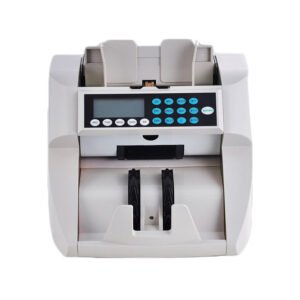
For the cash office that sits alongside cheque issuance, the same logic applies: match the device to the volume, and buy the evidence trail with it. A currency counter with a printing function exists for the same reason a cheque writer keeps a ledger, and the two sit in the same reconciliation workflow. For a broader view of how cash handling equipment fits together in a branch, this guide to maintenance programs for cash handlers covers the service side of the same fleet.