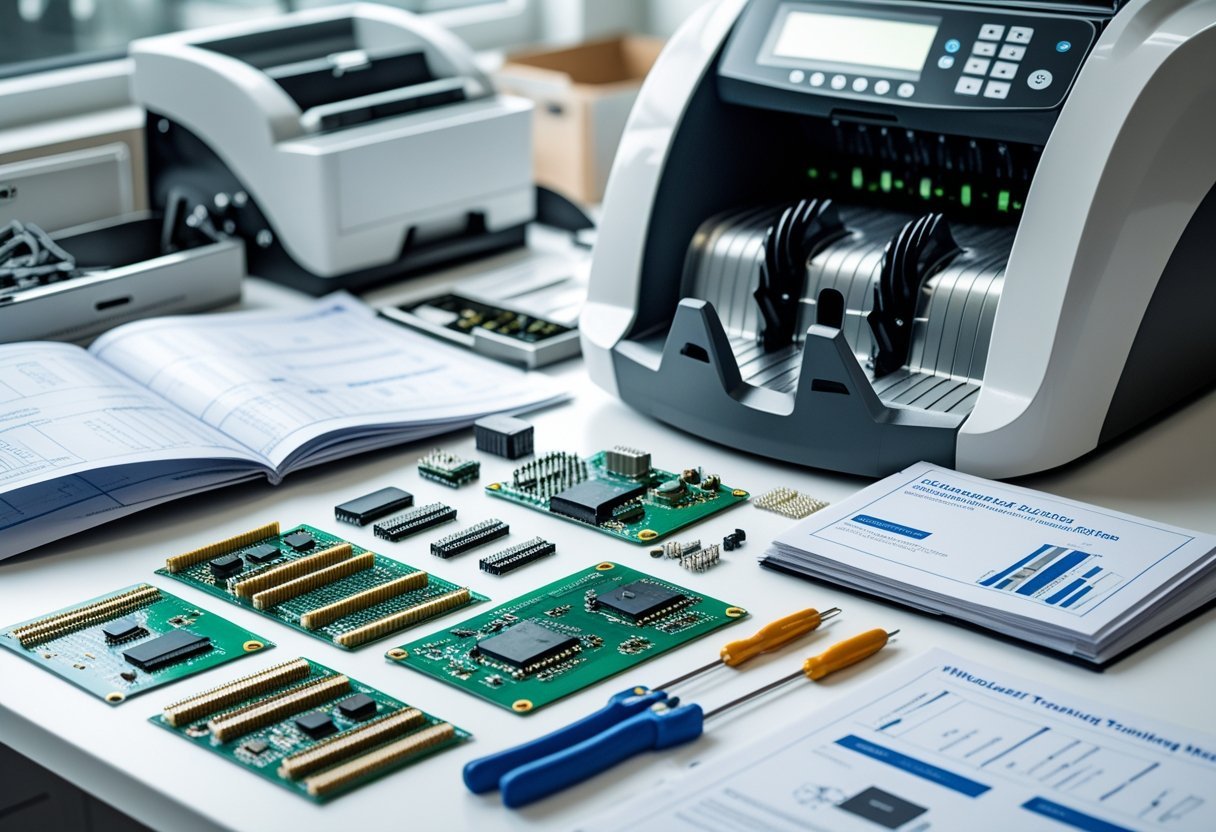
A counterfeit money detector is often sold as a single decision: buy a machine, point it at a note, accept the answer. Anyone who has operated cash equipment at scale knows the reality is more layered. A detector is a system of sensors, thresholds and rules that must be matched to the currencies you accept, the volume you process and the risk you can absorb if one bad note slips through. This guide explains what these machines actually verify, what the 2025 counterfeit statistics say, and how to select equipment for a bank back office, a retail cash office or a single point of sale.
What Counterfeiting Looks Like in 2025
The most common mistake in counterfeit planning is assuming a uniform threat. In practice, the threat is highly concentrated in specific denominations and specific environments, and it moves year to year. The European Central Bank publishes the most complete annual dataset on this. In 2025, 444,000 counterfeit euro banknotes were withdrawn from circulation, a decrease of 20% compared with 2024, and the proportion of counterfeits fell to 14 per million genuine banknotes in circulation, among the lowest levels since the euro was launched.
Table 1: Counterfeit euro banknotes, 2024 vs 2025
| Indicator | 2024 | 2025 |
|---|---|---|
| Counterfeit notes withdrawn | 554,000 | 444,000 |
| Counterfeits per million genuine notes in circulation | 18 | 14 |
| €20 + €50 share of counterfeits | Over 75% | About 80% |
| Counterfeits found in euro area countries | 97%+ | 96.8% |
Source: European Central Bank press release, 27 February 2026.
The denomination breakdown matters even more than the totals. In 2025, €50 notes accounted for 53.2% of all counterfeits and €20 notes for 27.0%, while the low-value denominations that dominate everyday transactions barely registered: €5 notes were just 1.4% and €10 notes 6.4% of the total. High-denomination €100 and €200 notes, despite their attractive value per note, were 7.9% and 3.3% respectively, because they are scrutinized far more carefully at the till.
Table 2: Share of counterfeit euro notes by denomination, 2025
| Denomination | €5 | €10 | €20 | €50 | €100 | €200 | €500 |
|---|---|---|---|---|---|---|---|
| Share of counterfeits | 1.4% | 6.4% | 27.0% | 53.2% | 7.9% | 3.3% | 0.8% |
Source: European Central Bank, 2025 counterfeit statistics.
The picture in the United States is consistent in spirit if not in numbers. The U.S. Secret Service, which investigates currency counterfeiting, reports that the $20 note is the most counterfeited denomination, and that 10.4% of the counterfeit banknotes passed in the United States in 2025 were “altered design notes” — notes printed with foreign text, motion-picture markings or other obvious indicators that counterfeiters try to remove or conceal. The agency’s holiday-season advisory describing a $5.94 million seizure of fake $100 bills makes a useful point for cash handlers: some fakes are crude enough that a trained eye catches them in seconds, but they still get passed in dark bar corners and at fast-food counters where staff are busy and lighting is poor.
Two practical conclusions follow from this data. First, your detection effort should be weighted toward the notes that are actually counterfeited in your market — in the euro area that means €20 and €50, in the United States the $20 and $100. Second, the large majority of counterfeit notes are caught today because most fakes are poor imitations with missing or badly copied security features. Machines and trained staff both matter; neither should be treated as a substitute for the other.
The Security Features a Detector Has to Read
To understand what a counterfeit money detector does, it helps to start with what the issuing authorities build into the notes themselves. Every major currency publishes official descriptions of its security features, and those features exist in two groups: features a human can check (feel, look, tilt) and features that are designed to be verified by machine sensors.
The United States designates each banknote page with its features: the $20 note carries a watermark portrait, an embedded security thread, color-shifting ink in the numeral that shifts from copper to green when tilted, microprinting, and raised intaglio printing that you can feel. The Eurosystem takes a similar approach with the Europa series: a portrait hologram, a portrait watermark, the emerald number that shifts color, and raised printing, all described in its “feel, look and tilt” guidance. The Bank of England’s polymer notes add a further dimension, since features such as the translucent windows and foil holograms behave differently on polymer substrate than on paper.
Table 3: Major security features and how machines read them
| Feature (example) | Human check | How a machine verifies it |
|---|---|---|
| Watermark portrait (USD, EUR) | Hold to light | Transmitted-light optical measurement of thickness variations |
| Security thread (USD, EUR) | Hold to light | UV fluorescence position, IR absorption and magnetic segments |
| Color-shifting ink (USD $10–$100, EUR emerald number) | Tilt the note | Optical comparison of ink reflectivity at set angles |
| Intaglio raised print (all) | Feel the texture | Surface relief and print-density analysis |
| Hologram / foil patch (EUR portrait hologram, GBP foils) | Tilt under light | Optical recognition of diffraction pattern position |
| 3-D security ribbon (USD $100) | Tilt the note | Optical pattern check for images moving in opposite directions |
| Polymer substrate (GBP, CAD, AUD) | Feel the crisper note | Thickness, stiffness and optical transmission profile |
Feature descriptions per uscurrency.gov, the ECB and the Bank of England; machine verification methods are the standard techniques implemented in commercial banknote handling equipment.
The key insight for buyers is that no single sensor reads every feature. UV lamps see the fluorescent response of threads and fibers. Infrared sensors see which inks and elements absorb infrared light, which is why genuine notes have predictable “signatures” under IR illumination. Magnetic heads read the magnetic properties embedded in specific print segments. Optical sensors and CIS (contact image sensor) bars read patterns, geometry and printed detail. A serious counterfeit money detector is therefore defined not by having one technology but by combining several and cross-checking them against stored currency profiles.
We have covered the physics of these sensing technologies in detail in a separate article on banknote authentication sensors; the short version is that each sensor family catches a different class of imitation, and the weakest link is whatever feature the counterfeiter chose not to copy.
Detection Technologies, Layer by Layer
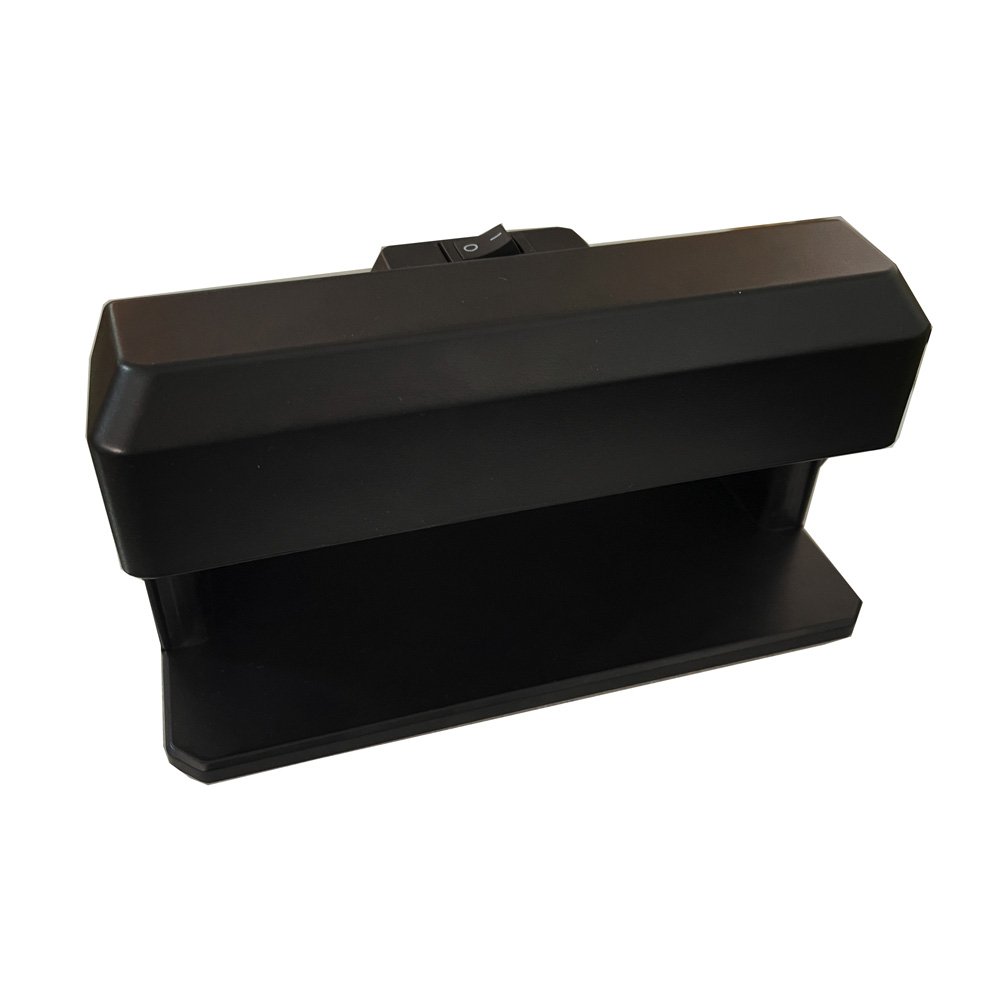
Commercial detection equipment sits on a spectrum. At the simplest end is the UV lamp — a fluorescent tube that makes security threads and paper fibers glow at defined positions. It is cheap, fast and effective against the crudest fakes, which is why it remains popular at single-point retail counters. Its weakness is that modern counterfeiters routinely print fluorescent imitation threads, and an operator under time pressure may not notice a thread glowing in the wrong place or glowing too brightly.
Next come value-counting machines with basic authentication: UV and magnetic detection built into the transport path. These check each note in milliseconds against the expected fluorescent and magnetic response, rejecting notes that fail. They process mixed stacks at full counting speed, which makes them the workhorse of retail cash offices and small bank branches. Their limitation is the depth of the reference profile: a machine that only knows a few currencies, or only a few denominations per currency, will reject genuine notes it does not recognize and may miss fakes engineered to pass shallow checks.
The upper tier is multi-point detection: UV, magnetic, infrared and size/optical checks evaluated together against a per-denomination profile, frequently with software that can be updated as new currencies and counterfeiting patterns emerge. This is the class of equipment used in bank back offices and cash centers — the tier occupied by established global vendors such as Cummins Allison as well as direct-from-manufacturer sourcing — and it is also the class that currency authorities implicitly require — the Eurosystem’s banknote handling framework, for instance, defines how professional cash handlers’ machines must authenticate and recirculate notes, and machine testing procedures are published openly by the ECB.
For readers selecting between these tiers, the decision variables are not exotic: notes per hour, currencies supported, the number of detection points per note, update capability, and what happens to a rejected note (straight eject into a separate pocket, or a stop that requires operator intervention). A machine that cannot update its currency profiles is a depreciating liability, because every central bank refreshes its note designs on its own schedule.
One further distinction catches buyers out: a dedicated detector and a counting machine with detection are different purchases, and confusing them produces the wrong station. A compact detector examines one note at a time and is operated by a person who decides what to do with each result. A counting machine with authentication processes an entire stack without operator attention, which is the only workable approach when deposits arrive in bundles of several hundred notes — but it hands every judgment call to the reject logic, so the reject handling design (pocket, straight eject, or halt) becomes an operational decision in its own right. Sites that process bundled deposits with a single-note detector usually abandon the process within weeks, not because the hardware failed but because the workflow did.
How Devices Are Tested and Certified
Buyers often assume that all machines sold as “with counterfeit detection” have been independently verified. That assumption deserves examination. In the euro area, the ECB maintains a public framework: machine testing procedures for banknote handling machines that recirculate notes to the public, plus published lists of tested counterfeit detection devices that help professional users choose equipment suited to their needs. Devices on those lists have passed defined tests against both genuine notes and counterfeit samples.
In the United States there is no equivalent public certification program for commercial detectors; the Federal Reserve instead publishes fitness and authentication requirements for notes recirculated by depository institutions, and the Secret Service and uscurrency.gov provide educational material on manual verification. The practical consequence for buyers in the US and most other markets is that certification claims are contractual, not regulatory: your acceptance test defines the standard. This is why we recommend a documented accuracy test with your own mixed sample of known genuine and suspect notes before payment — a procedure we described step by step in an earlier article on banknote counter acceptance testing.
When you evaluate vendor claims, three questions separate serious manufacturers from importers with a catalog. One: which detection points does each model actually contain — UV, MG, IR, size, CIS — and are they per-denomination enabled? Two: how are currency profiles updated, and is the update service included for the currencies you process? Three: what rejection evidence does the machine produce — a code that says “suspicious” tells you nothing, while a code that names the failed check (for example, IR mismatch or magnetic profile deviation) lets your cash office manager confirm or clear the rejection with a manual check. Vendors who cannot answer these questions in writing are effectively asking you to be their test engineer.
Matching Detection Levels to the Point of Sale
Counterfeit risk is not evenly distributed across your operation, and equipment spending should follow the risk. The tables above show counterfeits concentrate in mid-denominations passed at busy counters; risk also concentrates where notes are aggregated, because one fake buried in a deposit of three hundred notes is far easier to miss than one handed across a counter in isolation.
Table 4: Deployment tiers and realistic detection expectations
| Deployment point | Typical equipment | Primary goal |
|---|---|---|
| Single POS / till | UV lamp or compact MG/UV detector | Stop the crude fake at first contact; seconds per note |
| Retail cash office | Value counter with UV/MG/IR detection | Sweep the full deposit; reject with reason code |
| Bank teller line | Counter with multi-point detection per denomination | Authenticate customer deposits at counting speed |
| Bank back office / cash center | Multi-currency processing with updateable profiles and reject logging | Recirculation-grade authentication and audit trails |
Deployment guidance based on published central bank frameworks for professional cash handlers.
Notice what this table does not do: it does not claim that a $60 UV lamp protects a cash center, or that a bank-grade processor is money well spent behind a single convenience-store till. Over-equipment at low-risk points wastes budget that should go to training and to the aggregation points where risk actually accumulates.
Where Detection Fails in Practice
The failure modes of counterfeit detection are rarely sensor failures in the dramatic sense. They are operational, and they cluster in four places.
Worn transport and dirty sensors. Belts, feed rollers and sensor windows collect paper dust, ink residue and lint. A CIS bar or UV window filmed with grime reads every note slightly wrong, which shows up first as an increase in false rejections of genuine notes. The usual human response is to disable the sensitivity or “just this once” accept the rejected note — which is precisely how a genuine note check gets bypassed a hundred times until a real counterfeit walks through the same path. Scheduled cleaning with the manufacturer’s kit is not a maintenance nicety; it is part of the detection guarantee.
Calibration drift against currency changes. When a central bank issues a redesigned series, every machine in the country is briefly wrong: old profiles reject the new genuine notes, and counterfeiters exploit the confusion window to pass fakes of the old design. Organizations that treat currency updates as routine infrastructure — with a defined update path per machine family and a notice to staff — pass through the changeover quietly. Organizations that find out when tellers complain spend that window arguing with their equipment.
Condition mix in the input. Heavily soiled, taped or torn genuine notes produce sensor readings that overlap with imitation features. Detection thresholds have to separate three populations — clean genuine notes, worn genuine notes and counterfeits — and the tighter the counterfeit imitation, the closer worn genuine notes sit to the decision boundary. This is the same distinction central banks manage in fitness sorting, where the threshold definitions differ by denomination and design generation. For a detector buyer, the practical takeaway is to test candidate machines on your own worst notes, not on the crisp specimens from a sales demo pack, because the demo pack flatters every machine.
The human override. No sensor list survives an operator who accepts every rejection “to keep the queue moving.” The remedy is procedural rather than technical: a short escalation script at each counter, a visible log of accepted rejections, and periodic sampling of what was accepted. Sites that audit accepted rejections monthly catch both the slacking patterns and the emerging local counterfeit patterns early.
Where Buyers Get It Wrong
Mistake 1: Treating detection as one number. “99.9% accurate” is a marketing sentence, not a specification. Accuracy depends on the currency, the denomination, the note’s condition and the counterfeit generation being tested. Insist on per-denomination test results and run your own acceptance sample. The buyers we work with who avoided counterfeit losses all did the same thing: they processed their own known-good and known-suspect samples before signing, and they wrote the acceptance criteria into the purchase order.
Mistake 2: Ignoring the currencies behind the counter. A machine profiled only for the local currency will misbehave exactly when a foreign note arrives — either rejecting genuine notes or, worse, counting them without authentication. Multi-currency businesses (exchange counters, border retail, tourism districts, airports) need profiles for every currency they accept, and the profile list should be contractual.
Mistake 3: Buying detection without an escalation process. When a machine rejects a note, the counter staff need a defined next step: manual check, comparison with a known genuine note, retention and reporting per local rules. In the euro area, professional cash handlers operate under the ECB’s recirculation decision, which defines how suspect and counterfeit notes are handled; in the US, the Secret Service’s Know Your Money guidance asks businesses to hand suspect notes to authorities rather than return them to circulation. Equipment that creates rejections without a process merely creates arguments at the counter.
The Pre-Purchase Checklist
Before you sign any purchase order for detection equipment, work through the following list. It is deliberately written for a buyer comparing two or three quotations, not for an engineer reading datasheets. The list takes an afternoon to complete and, in our experience, eliminates most of the disagreements that surface after delivery.
- Map your denominational exposure first. Pull the last three months of notes processed by value and by denomination. If your market mirrors the euro-area pattern, concentrate detection on the mid-denominations that carry 80% of the counterfeit risk.
- Require a written list of detection points per model. UV, magnetic, infrared, size and optical checks, each with a yes/no per currency profile — not a brochure phrase like “advanced counterfeit detection.”
- Ask how currency profiles are updated. Who ships updates, how often, for which currencies, and at what cost after the first year? A detector with frozen profiles ages quickly.
- Run your own acceptance test. Use 1,000–10,000 of your own notes, including any suspect samples your region has seen, and test each model three separate times. Compare rejection consistency, not just totals.
- Test with your worst-condition notes. Include soiled, taped and heavily creased genuine notes in the acceptance sample. A machine that is brilliant on crisp demo notes and unstable on your real float will poison the counter with false rejections.
- Check reject readability. Rejections must name the failed check and be retrievable later for audit. A machine whose only output is “reject” cannot support an investigation.
- Match speed to the real station. A teller counter needs counting speed with authentication; a back office needs throughput and reject pockets. Do not pay for back-office throughput at a single till.
- Plan the cleaning and consumable schedule. Ask for the cleaning interval, the kit required, and the guaranteed availability period for wear parts — belts, feed rollers and lamps — plus the response time for service calls. For buyers sourcing from manufacturers directly, request OEM documentation and confirm the same model family is supported across your branches.
- Write the escalation procedure before the machine arrives. Decide what staff do with a rejection, who resolves disputes, and how accepted rejections are logged. The machine is only half of the detection system.
- Put the acceptance criteria in the contract. The quotation that wins should be the one that commits to measurable detection behavior on your sample, not the one with the lowest price per feature claimed.
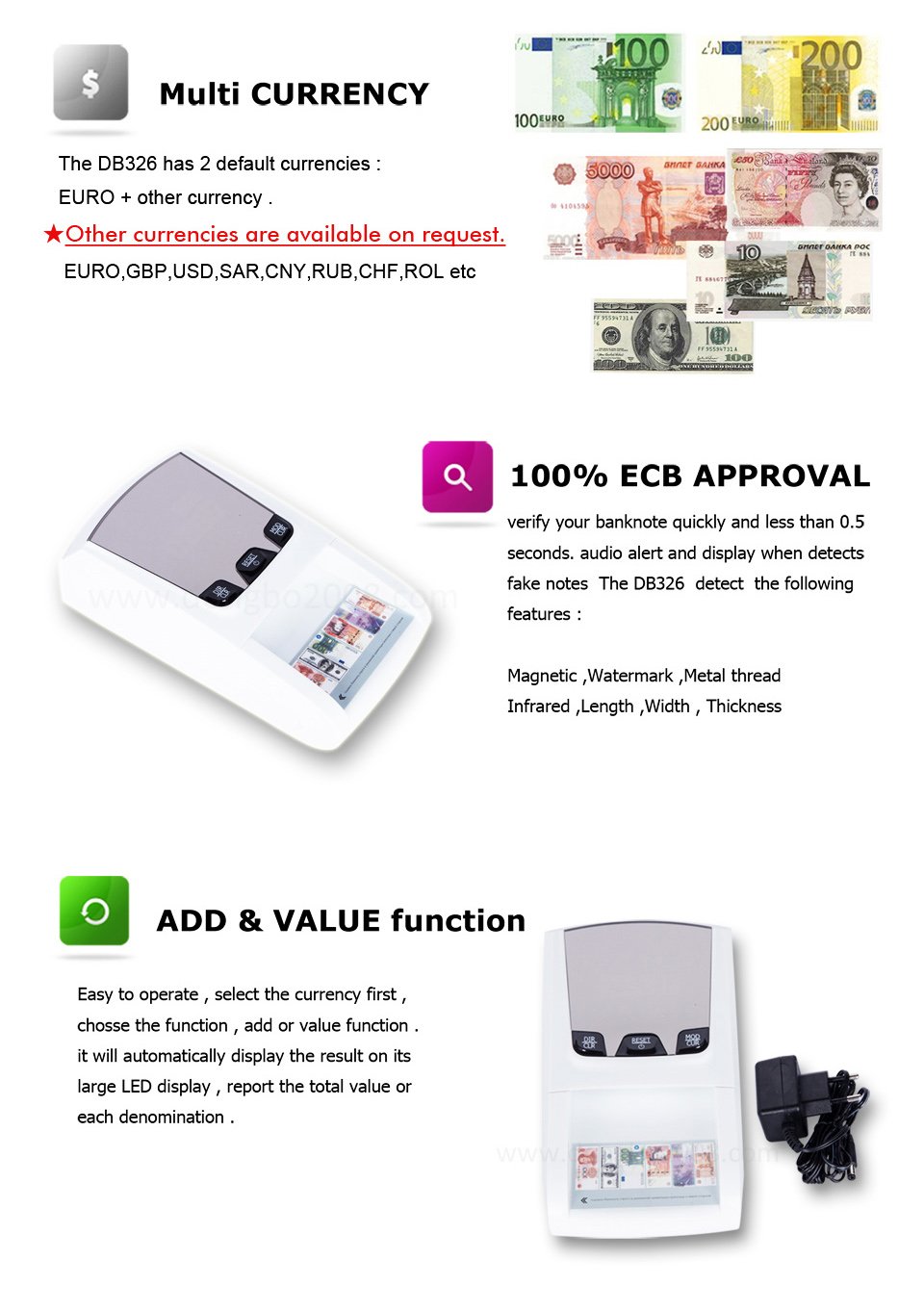
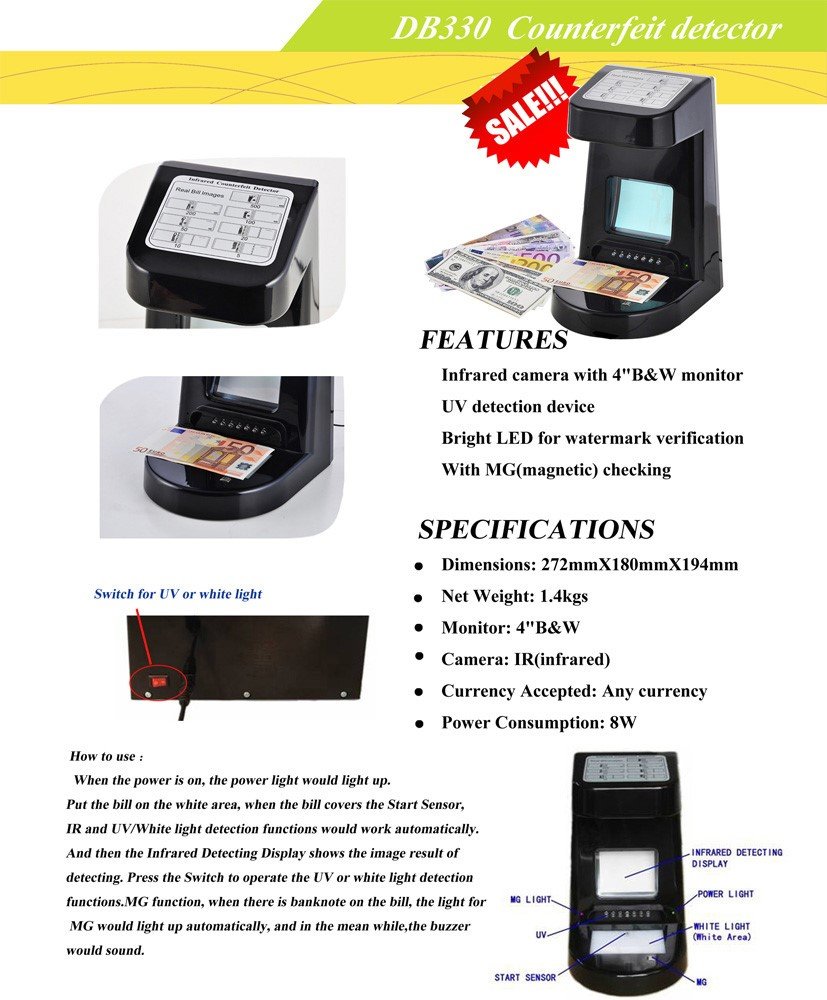
Equipment built to this standard — for example, detector models such as the DB326 and DB330 from Zhongshan Dongbo Financial Devices, or LED-based verification units like the DB017 — is straightforward to evaluate, because the detection points and rejection behavior are specified rather than implied. Whatever brand you shortlist, the checklist above will tell you quickly whether the vendor is selling you a verified system or a labeled box.
Counterfeiting in 2025 is, by every published measure, low and falling — but it has not disappeared, and it concentrates exactly where busy cash handlers relax their guard. A detector chosen with the discipline described here, matched to your real denominational risk and backed by an acceptance test, turns that residual risk into a managed, auditable process.