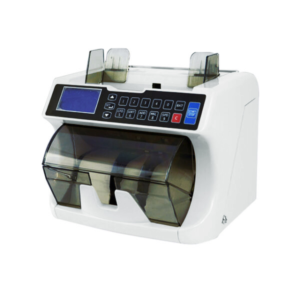
Every banknote counter on the market claims accuracy figures north of 99.9%. The claim is usually true — and almost useless, because it was measured on the vendor’s test deck, in the vendor’s lab, with notes in the vendor’s chosen condition, on the operating mode the vendor chose to demonstrate. The first week in your branch, counting your notes, in your humidity, tells a different story. The gap between those two stories is what an acceptance test exists to measure.
This article sets out a practical acceptance protocol for banknote counters and mixed-value machines: how to define accuracy precisely, how to build a test deck, which published thresholds to borrow as benchmarks, how to score results, and which clauses to attach to the purchase order so that test results have commercial consequences.
Define accuracy before you test it
“Accurate” is not one property. A counter can fail in four distinct ways, and each has a different cost to your operation:
- Count error. The reported note count differs from the true count — chain-fed doubles, misfeeds, or notes skipped by worn rollers.
- Denomination error. In value counting mode, a note is classified as the wrong denomination. This is the error that quietly corrupts balances, because a stack of 100 notes read as $50s when 20 are $100s still sums to a plausible number.
- False reject. A genuine note is rejected as suspect or unfit. Each one costs an operator intervention — seconds in retail, minutes in a bank back office with supervision sign-off.
- Missed counterfeit. A suspect note passes as genuine. This is the costliest error and the one vendors’ 99.9% claims are least likely to have stress-tested with current-generation counterfeits.
Insist that any accuracy claim is broken down by these four categories. A machine with a superb count record and a weak denomination record is fine for a bakery and unacceptable for a bank cash desk; the aggregate number hides exactly the difference that matters.
Borrow the central bank thresholds as your benchmark
You do not have to invent pass criteria. The Eurosystem tests banknote handling machine types against published requirements, and those thresholds make a demanding, defensible benchmark for any currency purchase. The ECB’s common test procedures specify that machines must pass with no counterfeits or test documents classified as genuine, at least 90% of tested genuine notes classified as fit, and — for customer-operated machines — no more than 1% of genuine notes mis-sorted, with at least 90% of counterfeits landing in the counterfeit or suspect categories (ECB test procedures). Table 1 condenses the requirements.
| Test | Requirement to pass |
|---|---|
| Counterfeit detection | None of the Eurosystem counterfeits or test “additional documents” classified as genuine (categories 4a/4b) |
| Genuine-note treatment | At least 90% of tested genuine euro notes classified as fit genuine notes |
| Unfit-note leakage (fitness test) | No more than 5% of unfit notes classified as fit genuine (category 4a) |
| Customer-operated machines | No more than 1% of genuine notes not sorted as genuine; at least 90% of counterfeits classified in category 2 or 3 |
| Unsupported denominations/orientations | All rejected, never counted as genuine |
| Test deck currency | Updated roughly every two months with counterfeits recently found in circulation; results valid for one year, with annual retesting |
Source: ECB, Procedures for testing banknote handling machine types.
Two details in that table deserve emphasis. First, the test deck is refreshed roughly every two months with counterfeits recently found in circulation — vendors who last validated a machine years ago are measuring against yesterday’s threat. Second, results are valid for one year with annual retesting required, which is exactly the re-verification cadence you should apply to your own machines after service, firmware or profile updates.
Build a test deck that represents your reality
The deck is the experiment; everything downstream depends on its design. Five components:
- Volume. For a machine that will process thousands of notes daily, a deck of 5,000–10,000 notes gives you resolution to measure sub-0.5% error rates. Below 2,000 notes, a single error shifts your measured accuracy by 0.05% and noise dominates signal.
- Denomination coverage. Every denomination the machine must classify, weighted roughly to your real mix. If your deposits are 60% low denominations, the deck should be too — testing only crisp high denominations flatters the machine.
- Condition spread. Mix crisp, average, and genuinely worn notes, plus a few damp and taped ones if those occur in your flow. Fitness thresholds matter to real operations; our article on fitness sorting explains what machines are actually judging.
- Foreign and adjacent-currency notes. Feed 2–5% notes from currencies the machine is not profiled for. It must reject them, not absorb them into the count.
- Known suspects. Include any reference counterfeits you are legally permitted to hold, or skip this component and rely on the vendor’s documented detection rates. Never acquire counterfeits informally.
Record the deck composition on paper before the first run: counts per denomination, per condition class, per currency. Every later measurement is relative to that sheet.
Run the protocol like a lab, not like a demo
Demo-room results are corrupted by three things: curated notes, perfect feeding, and no repetition. Strip all three out.
- Three full runs minimum, reshuffling the deck between runs. Systematic errors — the same denomination merge every run — are firmware problems. Random errors — different rejects each run — point to feed mechanics or condition sensitivity.
- Randomise feed order. If your deck runs in denomination blocks, the machine is learning nothing; shuffled stacks replicate real deposits.
- Use all four orientations if the machine claims four-way feeding, and note per-orientation results. Orientation-specific reject spikes are a real field complaint and easy to catch here.
- Log the environment. Temperature and humidity affect paper behaviour and sensor readings. Testing a machine destined for a tropical market in an air-conditioned European showroom is a category error; test in conditions matching deployment, or ask for units already fielded there.
- Time the runs. Record elapsed time per run in each mode. Throughput claims deserve measurement, not belief — a machine that jams on your worn notes twice per thousand effectively delivers a lower real speed than its rated rate.
Score the results the way acceptance engineers do
Score each run against the four error categories from the first section, using the pass thresholds you agreed in the purchase order. Table 2 shows a worked scoring sheet — the numbers are an illustrative example of the method, not measured field data.
| Measure | Run 1 | Run 2 | Run 3 | Agreed limit | Verdict |
|---|---|---|---|---|---|
| Count errors (per 10,000) | 2 | 1 | 3 | ≤ 3 | Pass |
| Denomination errors (per 10,000) | 0 | 1 | 0 | ≤ 2 | Pass |
| False rejects (per 10,000) | 95 | 110 | 88 | ≤ 100 (1%) | Fail — renegotiate |
| Missed counterfeits (of 20 inserted) | 0 | 0 | 0 | 0 | Pass |
| Foreign-note leakage (of 300 fed) | 0 | 1 | 0 | 0 | Fail — profile defect |
| Elapsed time, value mode (min) | 14.2 | 14.6 | 14.1 | ≤ 15 | Pass |
The example shows why three runs matter: run 2’s single denomination error could be an operator fluke, but the false-reject pattern (95/110/88) is stable around 1% — a property of the machine, not of chance. A stable miss is negotiable only as an explicit, documented acceptance; it should never be discovered after payment.
Note where the illustrative limits came from: the 1% false-reject ceiling mirrors the ECB’s own bar for customer-operated machines, and the zero-miss rule for counterfeits and foreign notes mirrors the counterfeit test. You are not being stricter than the industry standard; you are importing it.
Put teeth in the purchase order
An acceptance test changes nothing unless the purchase documents make results enforceable. Four clauses cost nothing to write and everything to omit:
- Payment on acceptance. Final payment due after the three-run protocol passes on decks you control, with the thresholds written into the contract.
- Remedy for systematic errors. Any error repeating across runs — denomination merges, orientation spikes, foreign-note leakage — is a firmware or profile defect the supplier corrects and retests before delivery, at no cost.
- Update obligation. The supplier commits to currency profile updates within a stated number of working days of central bank series changes, delivered via the machine’s field-update path, with a repeat of the acceptance deck after each update.
- Annual re-verification. Mirroring the Eurosystem’s one-year validity, each machine (or a sample of the fleet) is re-tested annually against the deck, with results kept on file — this doubles as your audit trail for supervisors and insurers.
Suppliers who resist these clauses are telling you something; so are suppliers who welcome them. How a manufacturer handles acceptance pressure is itself data. Established OEM producers — including Chinese manufacturers such as Zhongshan Dongbo Financial Devices, whose machines are profiled in our article on cash handling equipment certification — will already run internal versions of this protocol before shipping, and are usually comfortable contractually committing to the retest cycle.
Re-verify in the field, on a schedule
Acceptance testing is not a one-time ritual; accuracy drifts as rollers wear, sensors collect residue, and profiles age against new series. A light-touch field re-verification catches drift before it becomes a reconciliation problem:
- Quarterly: a 1,000-note reference deck, one run, in value counting mode. Log errors against baseline. Any systematic new error triggers a service call, not a shrug.
- After every service intervention: the same 1,000-note deck, before the machine returns to the desk.
- After every profile or firmware update: the full three-run protocol on the standard deck — updates change recognition behaviour in ways the changelog rarely mentions.
Keep the reference deck sealed and controlled like a calibration weight: it is only useful if its composition is known and stable. Rotate a backup deck so that wear on the reference notes does not itself create false rejects.
Five mistakes that ruin acceptance tests
Buyers who run protocols like the one above still lose information through avoidable mistakes. The five most common:
- Testing only the notes the supplier provided. Vendor-supplied demonstration notes are selected, inevitably, for how well they feed. If you cannot source your own worn notes in time, delay the test rather than run it on showroom stock — a week’s delay costs less than a machine that misclassifies your currency for a year.
- Counting only the total. Logging a single error number per run — “12 rejects” — discards exactly the breakdown that identifies the fault. Separate the log into count, denomination, false reject and foreign-note lines, every run.
- Skipping the reshuffle. A deck fed in the same order three times produces three identical correlated results, not three independent samples. Shuffle properly; alternate two people if it speeds up the work.
- Changing modes mid-test. If run one is in value counting mode and run two drifts into count-only because someone pressed a preset button, the comparison is void. Lock the mode per session and note it on the scoring sheet.
- No baseline for the reject pocket. Teams measure the notes that passed and forget to inspect what the machine rejected. Physically count and re-check the reject stack after each run; a machine that over-rejects by 3% is inflating its apparent accuracy on the passing stack.
None of these require special equipment — a ruled sheet, a marker, and discipline. That is the attraction of this kind of acceptance testing: the barrier is procedural, not financial, and a two-person team can complete a full three-run protocol on a 10,000-note deck in a normal working day including logging.
What vendors claim versus what to test
The closing comparison — the difference between brochure rows and measured rows — is the whole article in one table.
| Brochure row | What it omits | What to test instead |
|---|---|---|
| “Accuracy ≥ 99.9%” | Mode, note condition, currency and counterfeit generation unspecified | Four-category error rates on your deck, three runs, value mode |
| “Speed: 1,200 notes/min” | Count-only mode, crisp notes | Elapsed time on worn, shuffled notes in each mode you use |
| “Multi-currency support” | Profile depth and update cadence | Denomination accuracy per currency profile; foreign-note rejection |
| “Advanced counterfeit detection” | Detection rate on current counterfeits | Zero-miss requirement on documented test results; ECB-tested machine type where applicable |
| “Low false reject rate” | No condition mix stated | False rejects per 10,000 on worn and taped notes, tracked per run |
Summary
A banknote counter is one of the few capital purchases where a buyer can replicate the manufacturer’s own quality process for the cost of a day’s work and a prepared deck of notes. Define accuracy as four measurable error categories, borrow the Eurosystem’s thresholds — zero counterfeit passes, 90% genuine-note treatment, 1% false rejects for customer machines — as the benchmark, run three shuffled repetitions on decks that mirror your real note mix, and attach payment-on-acceptance plus update obligations to the purchase order. Machines that survive that protocol keep earning for years; machines that cannot pass it were never going to, whatever the brochure said.