Coins are the least valuable part of the cash drawer and the most expensive part to move. A note stack counts itself in seconds; the same value in mixed coins has to be sorted, counted, wrapped or bagged before a bank will accept it, and every minute an employee spends doing that is a minute of paid labour spent on pennies. Businesses that handle meaningful coin volumes eventually face the same decision: process coins in-house with a machine, hand them to a counting service, or keep rolling by hand. The right answer depends on volume, and the arithmetic behind that answer is more forgiving than most buyers expect.
This article compares the three routes with real throughput and wage data, works through the cost of processing 100,000 coins under each option, and identifies the volume thresholds where the decision changes.
Why Coin Handling Costs More Than Note Handling
Coins carry their cost in weight and time, not in value. A deposit of $500 in mixed US coins weighs roughly 11–28 kg depending on the mix of pennies and quarters, while the same $500 arrives as 5–25 notes. Banks and retailers therefore treat coins differently: most banks accept coins from account holders only in rolled form or through a coin machine at selected branches, and many charge non-customers or refuse loose coin altogether. Retail kiosk services fill that gap — at a price.
The wage side of the equation is documented. The US Bureau of Labor Statistics reports a median wage for bank tellers of $17.62 per hour (OEWS, May 2024), and retail cashiers earn similar or less. Every hour spent sorting and rolling coins is an hour at roughly that rate, which is the baseline all three routes must beat.
Route 1: Manual Sorting and Rolling
The traditional method uses free bank-supplied wrappers and staff time. It has no equipment cost and no service fee, which is why it survives. Its weakness is throughput: an experienced clerk sorting, counting and rolling mixed coins works at roughly 30–40 coins per minute including wrapper handling (a working assumption — measure your own operation before relying on it). At 35 coins per minute, 100,000 coins takes about 48 hours of labour per month.
Manual processing also has a silent second cost: miscounts. Hand-rolled deposits that come up short create reconciliation disputes with the bank, and loose foreign coins, tokens and damaged pieces slow the process further. For a fuller treatment of why coins defeat human counting, see our article on why coin counters miscount — the same material issues that confuse machines confuse hands even more often.
Route 2: In-House Coin Counting Machine
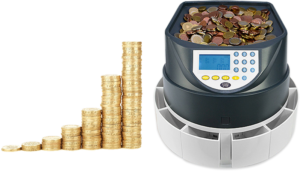
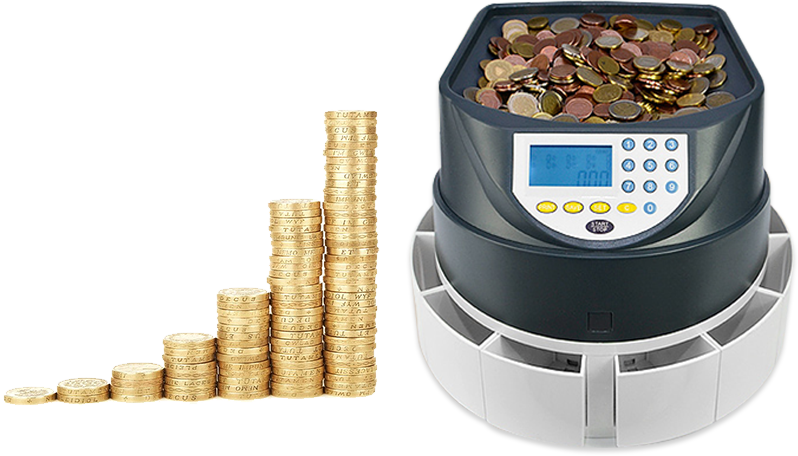
A benchtop coin counter automates the sorting and counting step while the operator only feeds the hopper and changes bags or cups. As a concrete benchmark, the DB380 coin counter from Dongbo’s coin counter series is rated at up to 330 coins per minute with a 300–500 piece hopper, a receiving cup of 80–150 pieces, batch and value counting displays, and an RS232 port for a thermal printer that documents each session.
Rated speed is not real-world speed. Bag changes, refills and jams cut effective throughput; across coin-handling operations a practical planning factor of about 62% of rated speed is a reasonable assumption for mixed, unsorted batches. On the DB380 that works out to roughly 205 coins per minute of effective rate — about six times faster than manual processing. At that rate, 100,000 coins needs about 8 hours of operator time per month, most of it passive.
The counter does not remove the bank’s wrapping requirement in every market: some banks accept bagged, counted coin from commercial depositors, others still want rolls. Counter and sorter machines handle both — for operations that also need denomination separation for vending or gaming floats, a dedicated sorter such as the DB450 routes each denomination to its own cup.
Route 3: Off-Site Counting Services and Kiosks
Kiosk services found in supermarkets count loose coins and pay out through a voucher, a gift card or a charity donation. Their published cash-voucher fee has been 11.9% at most locations for years (it varies by site, and the gift-card option carries no fee — but a business needs cash or bank credit, not gift cards). Banks and cash-in-transit companies also sell coin processing to commercial clients, usually priced per bag or per kilogram with minimum volumes, and terms are negotiable for regular deposits. Institutions such as Cummins Allison built their businesses on exactly this service layer, which is one reason it pays to know what your own volume is worth before you negotiate.
The kiosk fee is the easiest number to compare: it is a straight percentage of face value, forever. On $9,000 of coin (roughly 100,000 mixed coins at an assumed average of $0.09 per coin), a single percentage point is $90 a month; 11.9% is $1,071 a month, every month, with no terminal cost and no equipment to maintain.
The Cost of 100,000 Coins: Three Routes Compared
The two tables below put the routes side by side. All figures are illustrative: they use the documented wage and fee data cited above, the manufacturer’s rated speed, and the stated assumptions. Substitute your own wage, coin mix and quoted machine price before making a purchasing decision.
| Route | Effective rate (assumption) | Time for 100,000 coins | Labour at $17.62/h |
|---|---|---|---|
| Manual sort and roll | 35 coins/min (working assumption) | ~48 hours | ~$839 |
| Coin counter (330/min rated, 62% factor) | ~205 coins/min | ~8 hours | ~$143 |
| Kiosk service (cash voucher) | Handling + transport time (~2 h) | ~2 hours | ~$35 + 11.9% fee |
| Route | Recurring cost per 100,000 coins (est.) | One-off cost | Main risk |
|---|---|---|---|
| Manual | ~$839 labour + wrappers | None | Miscounts, disputes, staff turnover |
| In-house machine | ~$143 labour | Machine purchase (varies by market and configuration) | Maintenance, sensor cleaning, jams |
| Kiosk / service | ~$1,071 fee (11.9% of $9,000) + ~$35 labour | None | Fee rises or locations close; cash flow delay |
Assumptions: 100,000 mixed coins per month at an assumed average value of $0.09 per coin ($9,000 face value); wage of $17.62/hour (BLS OEWS May 2024, bank tellers, median); kiosk fee of 11.9% for a cash voucher as commonly posted; effective machine rate of 62% of rated speed. Real figures will differ by country, coin mix and negotiated terms.
Read together, the tables say something simple: at this volume the machine’s labour saving is about $696 per month against manual processing, and its advantage over the kiosk route is roughly $900 per month in avoided fees. Even allowing generously for maintenance and the machine’s purchase price, the break-even period at this volume is measured in months, not years. The machine route dominates from somewhere around 20,000–30,000 coins per month — below that, the arithmetic tilts toward manual rolling for small shops or a negotiated bank service for those without staff time.
What the Machine Route Demands in Return
An in-house counter is not free of obligations. Dust from circulated coins coats sensors, so weekly cleaning keeps reject rates low; bags and cups need changing, and the machine’s counting accuracy should be spot-checked with a pre-counted sample every so often. None of this exceeds a few minutes a day at moderate volume, and unlike a service fee, it does not scale with the value counted. Operations that run multiple currencies should also confirm that the machine’s value-counting profiles cover their coin sets — European operations handle up to eight denominations per the euro coin series, and the US mix adds its own diameter and alloy quirks that defeat naive machines, as covered in our coin miscounting guide.
For businesses weighing machines against services at scale — multi-branch retail, parking, laundries, gaming — the comparison changes again: transport, custody and reconciliation enter the picture, which is why we treat the high-volume case separately in choosing a coin sorter for casinos, lotteries and vending. And if you are deciding where coin processing fits into a wider cash room, the Federal Reserve’s overview of coin services is a useful orientation on how coin moves between banks and depository institutions in the first place.
Frequently Asked Questions
Do banks count coins for free?
Policies vary widely. Many banks accept rolled coin free from account holders, some run free coin machines at selected branches, and most charge non-customers or decline loose coin. Commercial depositors with volume often negotiate bagged-coin acceptance — ask before buying wrappers in bulk.
Is a counting machine accurate enough for deposits?
A maintained machine with a clean sensor path is more consistent than hand counting, and its batch mode lets you verify rolls against a preset count. Central banks treat this seriously enough to publish machine testing requirements with defined detection thresholds for recycling equipment — the same logic applies at shop scale. Run a pre-counted 200–coin sample weekly; if the machine matches it exactly, trust the rest. The known error sources — foreign coins, tokens, damaged pieces — are documented in our miscounting article.
What happens to the kiosk gift-card option — is it really free?
Yes, the gift-card redemption typically carries no fee, but the payout is store credit at specific retailers. Businesses that need bankable cash cannot use it, which is why the 11.9% cash fee is the relevant number for B2B decisions.
Can one machine both count and sort?
They are different mechanisms. Counters accumulate a total and support batch stops; sorters route each denomination to a separate cup using diameter, thickness and alloy sensing. High-volume operations usually need both functions — many buyers start with a counter and add a sorter as floats and recycling demands grow.
How fast does a coin counter pay for itself?
At the illustrative volumes above (100,000 coins/month), the labour saving against manual processing is roughly $700 per month, so typical payback is a few months. Below about 20,000 coins per month the payback stretches past a year, and manual rolling or a bank service usually wins.