A counterfeit detector does not see a banknote. It measures a set of physical properties and compares them with a template, then decides. Everything a buyer needs to judge such a machine follows from that sentence: the properties it can measure, the quality of the template, and the honesty of the comparison.
The stakes are easy to underestimate because the overall counterfeit rate is low. The European Central Bank recorded 554,000 counterfeit euro banknotes withdrawn from circulation in 2024, or 18 counterfeits per million genuine notes in circulation. That ratio sounds reassuring until you apply it to volume: a cash centre processing two million notes a week is likely to meet a counterfeit most weeks, and the cost of one accepted forgery is not the face value alone but the reconciliation case, the audit finding and the staff time that follows.
This article explains what each authentication channel on a counter or desk-top detector actually verifies, where each one fails, and how to specify a machine that suits the notes you handle rather than the brochure.

What a detector is actually measuring
Four physical families carry almost all banknote security, and each maps to a sensor type.
Fluorescence is the first. Genuine banknote paper is made without optical brighteners, so it stays dull under ultraviolet light while ordinary paper glows blue-white. Security fibres and patches printed with fluorescent ink light up in specific colours and positions.
Spectral response is the second. Ink reflects infrared light differently from the way it reflects visible light, and the pattern of that difference is characteristic of a given denomination and series. An infrared sensor compares reflectance at defined wavelengths against a stored reference.
Magnetism is the third. Certain inks contain iron oxide and are printed in defined positions; the magnetic thread embedded in many notes carries a coded signature. A magnetic head reads the presence, position and strength of that signal.
Geometry is the fourth, and the least discussed. A note has a thickness, a length, a width and an opacity. Two notes stuck together have twice the thickness. A note printed on the wrong substrate often transmits light differently. These are cheap measurements, and they catch a large share of crude forgeries before any spectral analysis happens.
The five sensor families, and what each one proves
Ultraviolet
UV is the oldest channel and still the most misunderstood. A UV lamp on a detector does two jobs: it checks that the paper does not fluoresce, and it checks that fluorescent features are present where they should be. On euro notes, the flags and stars on the front, the large denomination numeral and the security thread all behave in specific ways under UV.
The limitation is that UV tells you about paper and fluorescent ink, not about print quality. A forger using genuine banknote paper, or paper treated to suppress brighteners, defeats a UV-only check. This is why single-channel UV lamps belong in a drawer as a second opinion, not on a cash desk as the primary control.
Infrared
Infrared reads the infrared reflectance and absorption pattern of the printed design. Because the IR behaviour of a given ink set is difficult to reproduce without the original intaglio process, IR catches a wide range of offset-printed and digitally printed forgeries.
IR performance depends on calibration to the specific note series. A machine calibrated for the first euro series will produce false rejects, or false accepts, on a later series with revised print characteristics. When a central bank issues a new series, the detector needs the corresponding reference set, usually delivered as a firmware update or a currency card. A detector with no update path is a detector with a shelf life.
Magnetic and magnetic thread
Magnetic detection has two forms. MG checks the magnetic ink printed in specific areas of the note. MT checks the security thread: its presence, its position, and in more advanced implementations its coded pattern.
The distinction matters commercially. A detector marketed with “MG” alone verifies ink; a detector with “MT” reads the thread signature, which is considerably harder to counterfeit and is a strong discriminator on modern series. If a specification lists MG but not MT, ask whether the thread is read at all.
Size, thickness and double-feed
These channels are mechanical rather than chemical, and they are the workhorses of high-volume counting. Length and width tolerances are tight enough on most series to reject trimmed or enlarged copies. Thickness sensing, usually by a roller displacement sensor, detects two notes fed together and, in better designs, tape and heavy creases.
Double-feed detection is the channel that protects the count itself. A machine that counts accurately but feeds two notes as one produces a reconciliation error that looks like theft until someone finds the note. For cash offices, this is a bigger daily risk than forgery.
Watermark and spectral imaging
Higher-end detectors add transmitted-light imaging for watermark comparison, and some add multi-spectral analysis that compares the note against a reference at several wavelengths. These channels are what allow a machine to give a defensible verdict on a note that other channels find ambiguous.
They also cost money, and they slow the machine down. On a single-note detector, the trade-off is acceptable: one note every half second is still faster than a human. On a counter running at a thousand notes a minute, the imaging channel has to keep up with the feed, which is why counter-grade detection is coarser than detector-grade analysis.
| Channel | Property measured | Forgeries it typically catches | Where it can be defeated or misled |
|---|---|---|---|
| UV | Paper fluorescence, fluorescent ink features | Copier paper forgeries, notes with no fluorescent features | Genuine-paper forgeries, brighteners masked by coating |
| IR | Infrared reflectance and absorption of the design | Offset and digitally printed reproductions | Notes with correct IR ink behaviour, dirty or worn surfaces |
| MG | Magnetic ink presence and strength | Forgeries printed with non-magnetic ink | Notes with worn magnetic ink, poor sensor contact |
| MT | Thread presence, position and code | Thread-less forgeries, printed thread imitations | Damaged threads, notes with tape over the thread |
| Size and thickness | Length, width, opacity, caliper | Trimmed copies, two-note feeds, taped notes | Notes with folded corners, humidity-swollen paper |
| Watermark imaging | Transmitted-light watermark pattern | Printed or painted imitation watermarks | Heavy soiling, creases across the watermark area |
Authentication channels and their limits. Qualitative summary based on sensor principles; performance varies by model and calibration.
Why genuine notes get rejected
A false reject is not a neutral event. Every genuine note sent to the reject stack is handled again by a person, which is exactly the labour the machine was bought to remove. In a branch processing 40,000 notes a day, a two per cent false reject rate means 800 notes rehandled daily.
Five causes account for most false rejects.
Calibration drift. Optical references age. A sensor that has run for two years without a reference check may be comparing against a shifted baseline.
Contaminated sensors. Dust, paper fibre and ink residue accumulate on lenses and rollers. A dirty UV sensor reads a dull note as suspicious. Cleaning intervals belong in the operating procedure, not in the “when someone complains” category.
Note condition. A washed, ironed or heavily soiled note can fail IR and UV checks while remaining genuine. Machines with adjustable sensitivity let an operator trade false rejects against false accepts; that setting should be documented, because an auditor will ask.
Wrong currency profile. Loading a detector with a profile for the wrong series produces systematic errors. Multi-currency machines make this easier to get wrong, not harder.
Stale firmware. New counterfeit families appear continuously. A machine that has not been updated since installation is testing against yesterday’s threat.
The counterfeit picture, in numbers
The ECB publishes annual data that is useful for calibrating how much detection effort is justified, and where.
| Denomination | Share of counterfeits withdrawn in 2024 |
|---|---|
| €5 | 1.3% |
| €10 | 6.8% |
| €20 | 36.0% |
| €50 | 43.6% |
| €100 | 7.9% |
| €200 | 3.8% |
| €500 | 0.6% |
Counterfeit euro banknotes by denomination, 2024. Source: European Central Bank press release, 21 February 2025.
Two denominations account for more than three quarters of the total. That concentration has a practical implication for retail and transport operators: detection effort should be concentrated where the notes are. A supermarket that checks €50 notes carefully and waves €10 notes through is allocating attention in roughly the right proportion, if not the right absolute level.
The longer trend is equally informative. Counterfeits per million genuine notes fell from 48 in 2015 to 12 in 2021, then rose again to 18 in 2024 as post-pandemic volumes normalised.
| Year | Counterfeits per million genuine euro notes |
|---|---|
| 2015 | 48 |
| 2019 | 23 |
| 2020 | 17 |
| 2021 | 12 |
| 2022 | 13 |
| 2023 | 16 |
| 2024 | 18 |
Counterfeit detection rate per million genuine euro banknotes in circulation. Source: European Central Bank, 2025.
The ECB’s own guidance is that most counterfeits are easy to detect because they carry no security features, or poor imitations of them, and its public security feature guidance sets out the feel, look and tilt checks that any cash handler should know before touching a machine. That is an argument for consistent machine checking rather than for sophisticated analysis: the common case is crude, and the machine’s job is to apply the same test to every note, every time, without fatigue.
Outside the euro area the numbers look different but the lesson repeats. The US Secret Service reports on counterfeit currency seizures and notes that digital reproduction has lowered the skill needed to produce a passable copy, while the Bank of England publishes its own counterfeit statistics and guidance for retailers. Whichever market you sell into, the detection requirement is driven by the note series in circulation there, not by a global average.
Detector or counter: two different jobs
Buyers often ask for one machine to do both jobs. They are different jobs, and the difference is throughput against depth.

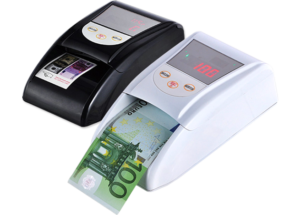
A desk-top detector verifies one note at a time and gives a verdict on that note. It suits teller positions, retail back offices, and any situation where a disputed note needs a documented answer. A model such as the DB326 counterfeit detector adds digital watermark analysis to the magnetic, thread, infrared and UV channels, which is the combination that gives a defensible result on a single note. Its detection time is under half a second per note, and it can run from mains, an internal battery or a vehicle cable, which matters for cash-in-transit and market traders.
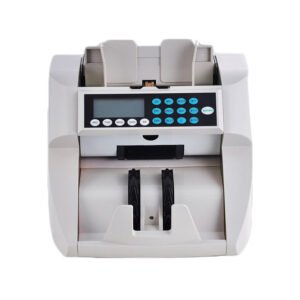
A counter verifies while it counts, at a thousand notes a minute or more, and its detection is necessarily a by-product of the feed. That is the right tool for volume: a banknote counter with authentication channels processes a full batch, flags suspects, and prints a record. What it cannot do is examine a single note in the depth a detector can.
The practical answer for most operations is one of each, in the same way a workshop has both a torque wrench and an impact driver. If the budget allows only one, choose according to which error costs more: an accepted forgery, or an hour of staff time per thousand notes.
Specifying a detector for tender
A specification that says “counterfeit detection: UV, MG” will be met by machines of wildly different capability. Six lines close most of the gap.
- Name the channels required, individually, and state whether thread reading is required in addition to magnetic ink detection.
- State the currencies and series to be covered, including any recently issued series, and require written confirmation that the reference set is current at the date of delivery.
- Require a documented update mechanism: firmware, currency card or PC connection, with the update interval and who supplies it.
- Ask for the false reject rate on circulated notes of the target currency, and the conditions under which it was measured.
- Require a cleaning and calibration schedule with the consumables listed.
- Require the detection result to be recorded, either on a printed receipt or in a log, so that a disputed note can be traced to a machine decision.
That last point is the one most often omitted and the one auditors value most. A detector that beeps is a convenience. A detector that records what it checked, when, and with which channel is evidence.
For buyers comparing detector designs in more detail, this review of the DB326’s detection features covers the operating modes, and this guide to machines with fake detection covers how detection requirements change between retail, transport and financial environments.
Frequently asked questions
Do I need UV detection if my notes have a magnetic thread?
Yes, because the two channels test different things. UV tests the substrate; the thread tests an embedded feature. A forgery that defeats one rarely defeats both, which is why detector specifications list channels in combination rather than choosing between them.
How often should sensors be cleaned?
It depends on volume and note condition, but a working rule is weekly for a machine processing several thousand notes a day, and daily in dusty or humid environments. Paper fibre accumulates on lenses faster than most operators expect, and a dirty lens reads as a sensitivity problem.
Can a detector tell me the note is genuine with certainty?
No machine can. A detector compares measured properties against a reference and reports whether they fall within tolerance. That is a strong signal, not a proof. For a note that matters legally, the answer comes from a central bank or police examination, and the machine’s role is to route the note there.
Why does my detector reject notes that a bank accepts?
Usually calibration, note condition or a stale reference set. Banknote paper swells in humid conditions, and a note that has been through a wallet for a month may sit outside a tight thickness tolerance. Check the sensitivity setting and the firmware revision before assuming a hardware fault.
Are multi-currency detectors slower?
Generally yes, because the machine has to identify the currency before it can apply the right reference set, and mixed-currency batches require more decisions per note. For a retail chain handling three currencies, this is a reasonable trade. For a single-currency cash centre, a dedicated profile is faster and produces fewer false rejects.
What is the difference between MG and MT on a specification sheet?
MG refers to magnetic ink detection, which verifies that magnetic ink is present in the expected areas. MT refers to magnetic thread reading, which verifies the thread’s presence and often its coded pattern. MT is the stronger channel on modern series, and a specification that omits it should be questioned.