A banknote that is too worn to be read is not money any more. It is a processing exception: a note that a cashier cannot verify by eye, an ATM will reject, and a central bank will destroy. The decision to pull it out of circulation is made thousands of times an hour, by machines, against numeric thresholds that most buyers of cash-handling equipment never see.
That is the gap this article closes. Below are the actual fitness criteria used by the Federal Reserve and the Eurosystem, the pass marks a sorting machine has to hit to be approved for recirculation work, and the practical questions that separate a machine that sorts notes from a machine that sorts them correctly.
The cash cycle has a quality gate, and it is mechanical
Physical cash circulates in a loop. Commercial banks deposit surplus notes with the central bank, withdraw fit notes to meet demand, and hand notes back to customers through branches and ATMs. Every one of those steps moves the same pieces of paper, and every pass through a wallet, a till drawer or a counting machine takes something off the note: ink, stiffness, a corner, the crispness that makes a security thread readable.
Left alone, the loop degrades. Notes in circulation get dirtier until the authentication features stop working reliably and the public loses confidence in the currency. Central banks handle this by acting as a quality filter: deposits are processed, genuine notes are graded for fitness, the fit ones go back out, and the unfit ones are destroyed and replaced with new print.
The Eurosystem makes the filter mandatory for anyone who recirculates euro notes. Under Decision ECB/2010/14, euro banknotes may only be put back into circulation after they have been checked for authenticity and fitness, and notes recirculated through customer-operated machines or cash dispensers must be processed by a machine type that has passed a test at a national central bank. Professional cash handlers cannot simply decide that their counting equipment is good enough.
The Federal Reserve runs a softer version of the same logic. Its recirculation policy sets out what a depository institution must do before it puts currency back into circulation, and the Cash Product Office publishes the fitness guidelines that turn a qualitative standard into measurable values. Both regimes land in the same place: the machine in the back office is now a compliance instrument, not a convenience.
The scale involved is easy to underestimate. In 2024 the Federal Reserve paid out 30.6 billion notes to depository institutions and received 29.8 billion back, according to its payments of currency to circulation data. Each of those notes passed through processing equipment at least once.
What “fit” means in the regulator’s own words
The Federal Reserve defines fit currency in Operating Circular 2 as “a note that is suitable for continued circulation and is sufficiently clean to allow its genuineness and denomination to be readily ascertained.” Unfit currency is “a note that is not suitable for further circulation because of its physical condition, such as torn, dirty, limp, worn or defaced.”
Read that definition carefully, because it explains the whole design of a sorting machine. The test is functional: can a person or a sensor still establish that the note is genuine and worth what it claims? A note fails not because it looks old, but because its condition interferes with authentication or denomination reading.
Ang Federal Reserve fitness guidelines then break that functional standard into individual measurements: soiling, ink wear, graffiti and stains, plus substrate defects such as tears, holes, missing corners, folded corners and tape. One rule matters for anyone configuring a machine: an item must fail at least one measurement to be unfit, and an item that marginally passes several measurements is still fit. There is no scoring system and no averaging. Each criterion stands alone.
The Eurosystem takes a different route to the same destination. Decision ECB/2010/14, Annex III, lists twelve visual criteria for manual fitness checking: soil, stain, graffiti, de-inked notes, tears, holes, mutilation, repairs, crumples, limpness, folded notes and folded corners. Machine sorting is expected to reproduce those judgements consistently, at speed, without an operator deciding case by case.
The numbers behind the decision
Soiling is measured as a loss of reflectivity in the unprinted areas, expressed as an L-value on a 0 to 100 lightness scale. The lower the reading, the darker the note. Ink wear is measured as the percentage of printed pixels on the portrait side that are more than 2 percent reflectance lighter than nominal, which is a technical way of describing a portrait that has rubbed away. Graffiti and stains are counted as visible markings larger than 9 mm² with a contrast at least 10 percent darker than the surrounding area.
The thresholds are not the same for every denomination. The table below reproduces the Federal Reserve’s surface fitness criteria.
| Denominasyon | Soil level, front (L) | Soil level, back (L) | Ink wear, both sides | Graffiti, area per side |
|---|---|---|---|---|
| $1 | Below 84.30 | Below 83.38 | 25% or more worn pixels | 40 mm² or more |
| $5 (Series 2006) | Below 77.44 | Below 79.32 | 25% or more worn pixels | 40 mm² or more |
| $10 (Series 2004) | Below 79.14 | Below 80.89 | 25% or more worn pixels | 40 mm² or more |
| $20 (Series 2004) | Below 77.43 | Below 75.35 | 25% or more worn pixels | 40 mm² or more |
Two details in that table are worth pausing on. First, the $1 threshold sits roughly seven L-values above the $20 threshold on the front side. A one-dollar note is allowed to circulate in a condition that would retire a twenty. That is a deliberate economic choice: small notes have a shorter life and a lower replacement cost, so the acceptable dirtiness is higher. A machine that applies one global soiling threshold across all denominations will either reject too many singles or pass too many twenties, and neither error is visible in a demo.
Second, the thresholds are series-specific. The $5 and $10 figures refer to particular design series because the reflectance of the paper and the print differs between designs. When a new series enters circulation, the numbers move. Any sorting specification that hard-codes a single set of values without a path to update them is a specification that will drift out of compliance within a few years.
Defects that are geometric, not optical
Roughly half of the fitness decision has nothing to do with how a note looks. It has to do with its shape, and with what has been stuck to it. The Federal Reserve sets measured limits for these as well.
| Defect | Unfit threshold | Why the machine cares |
|---|---|---|
| Length | Under 151 mm, with more than 50% of the note present | Short notes jam transport and skew the image window |
| Width | Under 63 mm, with more than 50% of the note present | Width is the primary denomination cue on many sensors |
| Holes and open tears | Total hole area over 15 mm², additive | Holes break the magnetic and UV signature |
| Tear depth on long edges | Over 3 mm, additive | Tears propagate into full splits at 1,600 notes per minute |
| Missing corner | Any corner over 72 mm² | Corners carry orientation marks used for alignment |
| Folded corner | Over 182 mm², or four folded corners at any size | A fold doubles apparent thickness and triggers double-feed errors |
| Tape | Longer than 9 mm, at least 0.05 mm thick | Tape masks magnetic ink and can fluoresce under UV |
The tape rule is the one that surprises buyers most often. A strip of clear household tape is nearly invisible to a human teller and completely opaque to a magnetic sensor. On a note with a magnetic security thread, tape along the thread path produces exactly the reading a counterfeit would produce. Machines that reject heavily taped notes are not being fussy; they are refusing to certify an authentication signal they cannot read.
The folded-corner rule explains a failure mode that shows up in almost every cash centre at some point: a stack that keeps stopping with a double-feed error even though the notes are separated. A corner folded back on itself presents two layers of paper to the thickness sensor in a 20 mm window. To the machine, that is indistinguishable from two notes travelling together. Operators who understand the geometry stop re-feeding the stack and start checking corners.
How a machine measures what a regulator defines
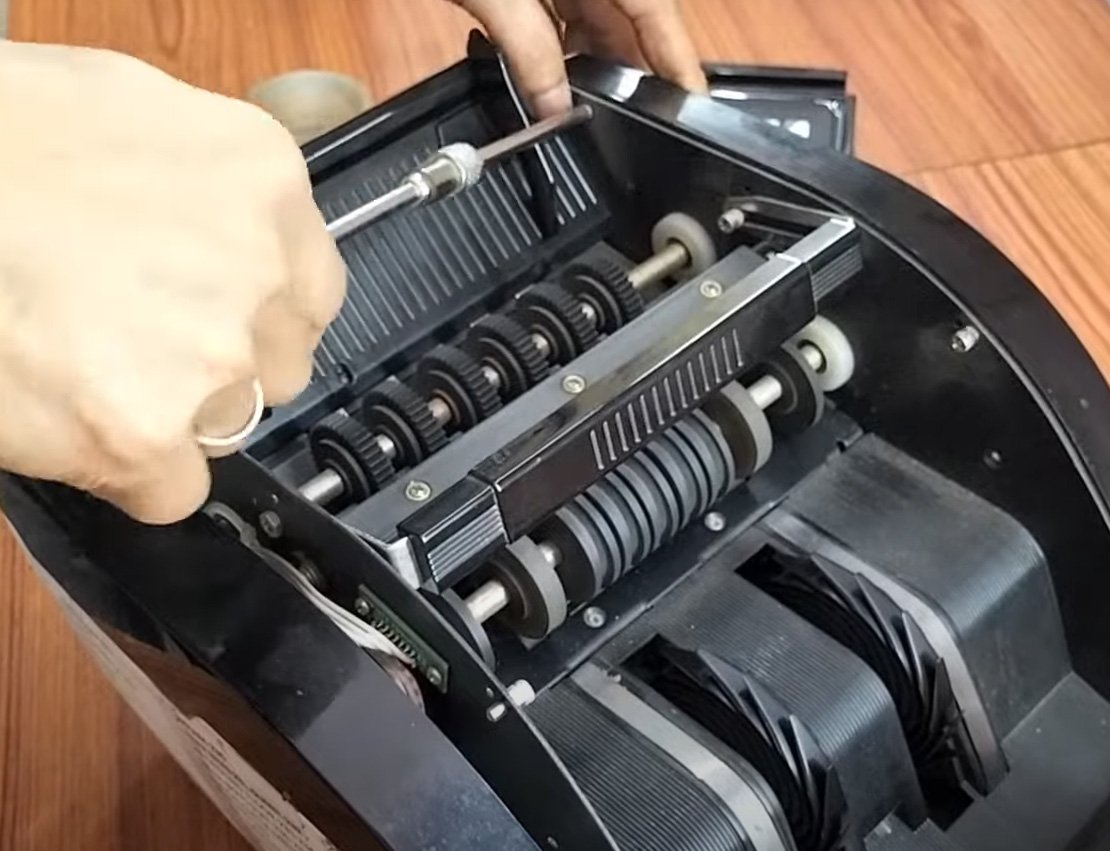
A fitness-capable machine is a stack of sensing systems arranged along a transport path, each answering a different question.
Colour and visible-light reflectance sensors answer the soiling question. They compare the brightness of unprinted regions against a reference for that denomination and series, which is how an L-value gets produced in the first place. The quality of this measurement depends less on the sensor than on the reference data: a machine calibrated on one print works badly on another, and a machine calibrated only on crisp notes misreads notes that are uniformly aged.
Infrared sensors answer a different question. IR reflectance and transmission respond to the ink chemistry and to the paper substrate, which is why IR is strong on denomination discrimination and weaker on heavily soiled notes, where surface dirt scatters the signal. This is the technical reason a machine may accept a dirty note as genuine but reject it as unfit, or the reverse.
Ultraviolet sensors look for paper fluorescence and for the UV features printed into the note. Under UV, most ordinary paper glows and genuine note paper does not, which is why UV catches photocopies and why UV is also the channel most affected by certain tapes, bleaches and detergents.
Magnetic sensors read ferromagnetic ink and, on many series, a magnetic thread or a magnetic code pattern. This is the channel that survives dirt best and folds worst, because a fold moves the magnetic material out of the read head’s window.
Thickness measurement is mechanical or ultrasonic depending on design. Roller-displacement micrometers infer thickness from how far a roller is pushed aside; ultrasonic sensors measure the time of flight through the note. Both detect double feeds, and both drift as dust accumulates on the measuring surfaces, which is why cleaning intervals belong in the specification rather than in the maintenance manual.
Finally, line-scan imaging ties the whole decision together. Modern sorters capture a full image of each note and run soiling, print wear, graffiti and geometry checks on that image, then attach the result to a transaction record. That record is what makes an audit possible: for any processed batch, the machine can say how many notes were graded fit, how many were graded unfit, and on which criterion.
If you want a deeper treatment of how the individual sensors behave and where each one fails, the companion article on mga sensor ng pagpapatunay ng banknote covers UV, IR, magnetic and magnetic-thread detection in detail.
The Eurosystem’s five-category model
The ECB approach is worth studying even for buyers outside the euro area, because it separates two things that get muddled in cheaper equipment: “not genuine” and “not fit”. A machine that only has one reject stacker cannot make that distinction, and the distinction has legal consequences.
| Category | What it contains | Required action |
|---|---|---|
| 1 | Objects not recognised as euro banknotes: wrong format, transport errors, large folded corners, missing parts, other currencies | Returned to the customer or operator; not credited |
| 2 | Suspect counterfeits: correct image and format, one or more security features missing or out of tolerance | Withdrawn from circulation, handed to national authorities within 20 working days, not credited |
| 3 | Notes that cannot be clearly authenticated, for example because of tolerance deviations or poor condition | Treated like category 2, but may be credited to the account holder |
| 4a | Genuine notes that pass every fitness check | May be recirculated |
| 4b | Genuine notes that fail at least one fitness criterion | Returned to a national central bank; must not be recirculated |
The practical implication is stacker count. A machine that handles recirculation work needs at least four destinations: fit, unfit, suspect, and reject. Counting machines with two stackers can count and authenticate, and many retail operations run perfectly well that way, but they cannot support a recirculation decision on their own.
Category 3 is the one that trips up procurement teams. It exists because authentication is probabilistic at the edges: a note may be genuine but too worn, or too contaminated, for a particular sensor to confirm a feature with confidence. The regulation does not pretend the machine knows everything. It creates a holding category for “cannot confirm”, requires that those notes leave the recirculation flow, and lets the institution credit the customer while the note goes for human review.
The pass marks a machine has to hit
The Eurosystem’s common test procedures set numeric acceptance criteria. A machine type does not pass because it looks accurate in a showroom; it passes because it meets thresholds against a test deck assembled by a national central bank.
| Test | Kinakailangan |
|---|---|
| Counterfeit detection | At least 90% of the counterfeit test deck sorted into categories 2 or 3, and none into category 4 |
| Fitness detection, unfit notes | No more than 5% of the unfit test deck sorted into category 4a |
| Fitness detection, fit notes | At least 90% of genuine fit notes sorted into category 4a |
| False rejection of fit notes | No more than 1% of genuine fit notes sorted into categories 1, 2 or 3 |
Those four numbers describe a trade-off that every operator lives with. The 5% limit on unfit notes reaching the fit stack is a ceiling on under-sorting. The 90% floor on fit notes reaching the fit stack, combined with the 1% ceiling on false rejection, is a ceiling on over-sorting. A machine can always hit one of them by sacrificing the other; the test exists to stop manufacturers from doing exactly that.
Test results are also time-limited. Under the decision, a successful test is valid for one year, and a machine type that can no longer detect all known counterfeits is removed from the published list. That is the structural reason software updates are part of the product, not an after-sales favour.
What over-sorting and under-sorting actually cost
Both directions of error cost money, and they cost it in different places.
Under-sorting pushes unfit notes back into circulation. In the euro area that is a compliance failure with a defined escalation path: a national central bank can require corrective measures within a time limit and, until the problem is fixed, prohibit the institution from recirculating the affected denominations. In any market, the commercial damage is quieter but real: ATMs jam more often, counter staff spend more time on manual verification, and customers receive notes they do not trust.
Over-sorting destroys value directly. Every fit note that a machine sends to the unfit stack has to be replaced by a new note at the central bank’s printing cost, and the institution carries the transport and handling of a deposit that should never have been made. The St. Louis Fed reports that about 85 percent of the currency deposited with it is fit, which sets a useful benchmark: in a well-run cash operation, the large majority of what comes in should be going straight back out. A branch seeing a fit rate far below that is usually looking at a calibration problem, not a customer behaviour problem.
Counterfeit performance sits alongside fitness performance, and the numbers explain why central banks keep tightening machine tests. The ECB recorded 554,000 counterfeit euro banknotes withdrawn from circulation in 2024, or 18 counterfeits per million genuine notes in circulation, with the €20 and €50 accounting for more than 75 percent of the total. Those rates are low, and they are low partly because machine testing works.
Matching machine class to site
Fitness sorting is not a single product category. It is a capability level, and buying above or below the site’s need wastes money in both directions.
A retail branch or a supermarket cash office needs counting, authentication and batch separation. A two-stacker counter with UV, magnetic, infrared and dimensional detection covers that requirement, and the note that fails authentication goes to a reject stacker for a supervisor to review. Fitness grading is unnecessary because those notes are going to a bank anyway, not back to a customer.
A bank branch that recirculates notes to customers has a different obligation. It needs at least a three-way split between fit, unfit and suspect, and it needs the transaction record to prove the split happened. That is the entry point for compact fitness-capable machines.
A cash centre needs throughput, and throughput arithmetic is unforgiving. A machine rated at 1,600 notes per minute is processing 96,000 notes an hour at continuous speed. Real output is lower, because stacks have to be loaded, strapped and reconciled, and because stops for jams and rejects consume time. At a realistic 60 to 70 percent duty cycle, a single 1,600-note machine delivers roughly 55,000 to 65,000 notes an hour of productive work, which is the number to use when sizing a shift against daily volume. Buying on the headline speed rather than the duty-adjusted figure is the most common sizing error in cash centre projects.
Dongbo’s own range sits mostly in the first two categories: counters and detectors for retail, branch and wholesale operations, such as the DB780A with a 300-note hopper and speed settings from 600 to 1,600 notes per minute, and the DB550 for higher-volume wholesale work. For full fitness sorting, buyers should confirm the machine’s stacker configuration and per-denomination fitness parameters against the criteria above rather than assuming that a high sensor count implies fitness capability. The full hanay ng produkto is organised by series for that comparison.
Questions that belong in the RFQ
Most RFQs for cash-handling equipment ask about speed, hopper capacity and price. Those three answers are easy to give and almost useless for predicting whether the machine will pass an audit in year three. The questions below are harder to answer, which is precisely why they are worth asking.
Ask for the fitness parameter list by denomination and series, and ask how those parameters are updated when a new series is issued. Ask whether the machine produces a per-batch record showing fit, unfit, suspect and reject counts, and whether that record can be exported rather than photographed off a screen. Ask what the false-rejection rate is on circulated fit notes, not on new notes, because new notes flatter every sensor.
Ask which sensor handles limpness, and whether limpness is measured directly or inferred from soiling. Many mid-range machines infer it, which is acceptable if the limitation is disclosed and unacceptable if it is not. Ask how the thickness sensor is cleaned and how often, and what the drift looks like over a shift. Ask whether the reject stackers are physically separate or share a destination under some modes.
Ask what happens to the machine when a new counterfeit family appears. The answer should involve a software update with a defined turnaround, not a service visit. Ask whether the machine type appears on any national central bank’s tested list, and if not, why not. Ask for the maintenance interval in notes processed rather than in months, because a machine in a busy cash centre reaches a month of wear in a week.
Checklist sa procurement
Use this list to compare offers on the criteria that determine fitness-sorting performance rather than on the criteria that are easy to print in a brochure.
- Fitness parameters are listed per denomination and per series, with a documented update path.
- The machine separates fit, unfit, suspect and reject into physically distinct destinations.
- A per-batch audit record exists and can be exported in a format the finance team can reconcile.
- False-rejection performance is quoted on circulated notes, with the test method disclosed.
- Limpness measurement is either direct or explicitly declared as inferred.
- Cleaning and calibration intervals are specified in notes processed, with consumable part numbers.
- Sensor set covers UV, infrared, magnetic, magnetic thread and dimensional checks, not a subset presented as a full set.
- Software update turnaround is defined in writing, including who pays for it.
- Tested-machine listing status is stated for the relevant jurisdiction, or the absence of one is explained.
- Throughput is quoted as a duty-adjusted figure for the site’s actual mix of denominations, not as a peak speed.
None of these questions require a technical background to ask, and all of them change the conversation. A supplier that can answer them is describing a machine it understands. A supplier that cannot is describing a catalogue page.