Two banknote counter quotes rarely look alike, and the difference is usually not the machine. One supplier quotes a unit price and a delivery date. Another quotes a unit price, a spare parts kit, a three-year service agreement and a training session. Buyers compare the first number, choose the cheaper machine, and then spend the next five years discovering what the second supplier had already priced in.

The useful comparison is not price. It is cost per thousand notes processed over the life of the equipment, and that figure is built from five lines that behave very differently from one another.
Line one: the machine itself
Capital cost is the only line most buyers model, and it is the least interesting. A counter is a mechanical device with a defined service life, typically five to seven years in daily commercial use before transport wear and spare part availability make replacement cheaper than repair. Spread over that period, the purchase price is a knowable annual figure.
What varies is what the price includes. A machine delivered without a spare parts kit has a lower headline cost and a higher first-failure cost, because the parts have to be ordered individually, shipped internationally, and paid for at single-unit pricing. A machine delivered with rollers, belts and a feed tyre has a higher headline cost and a first-failure cost measured in minutes.
For a single branch machine, the difference is small. For a rollout of twenty units across a retail chain, the spare parts question is worth more than any discount being negotiated.
Line two: consumables and wear parts
Banknote counters do not consume much, but they do wear. The parts that wear are predictable: feed rollers, separation tyres, transport belts, and the pressure rollers that hold notes against the sensors. In a busy cash office these are annual items; in a branch they may last several years.
Two specification details determine whether this line stays cheap. The first is whether wear parts are sold as individual items or only as assemblies, because an assembly that includes a sensor costs several times what a rubber tyre costs. The second is whether the part numbers are published in the manual, which determines whether a maintenance team can stock them before they fail or has to wait for a diagnosis and a shipment.
Dust is the hidden consumable. A counter pulls paper dust through its transport, and that dust settles on sensor windows. Machines designed for easy cleaning have removable transport covers and accessible sensor glass; machines that require partial disassembly to reach the sensors get cleaned less often, drift more, and produce more reject errors in the second and third year.
Line three: service and software
Service pricing splits into two models. Under a contract, the supplier charges an annual fee and covers labour and often parts. Under time and materials, the buyer pays per intervention. Contracts cost more in a good year and less in a bad one; the choice depends on how many machines are in the fleet and how much downtime the site can absorb.
Software is the line that buyers forget, and it is becoming the line that matters most. Authentication is a moving target: the ECB withdrew 554,000 counterfeit euro banknotes from circulation in 2024, and each new counterfeit family that reaches circulation can require an update to detection logic under the Eurosystem’s common test procedures. A machine whose firmware cannot be updated is a machine with a fixed capability and a declining one, because the counterfeits it was tested against are not the counterfeits it will meet in year four.
Ask two questions about updates: how often they are issued, and who pays. A supplier that charges for every update has an incentive to issue few; a supplier that includes updates in a service contract has an incentive to keep the machine current. Either model can work, but the cost belongs in the five-year total, not in a footnote.
Line four: downtime
Downtime is the largest cost in the model and the hardest to see, because it appears in the payroll and in the deposit schedule rather than in the equipment budget.
Consider a machine rated at 1,600 notes per minute. At continuous speed that is 96,000 notes an hour. Real output is lower once loading, strapping and reconciliation are counted, but even at a 60 percent duty cycle the machine is moving roughly 57,000 notes an hour. Every hour it is stopped costs the site that throughput, and if the deposit window closes at a fixed time, the work does not shift to later in the day; it shifts to people.
This is why the service response time matters more than the service price. A contract with a 48-hour response is cheap until the machine fails on a Friday before a long weekend. For a single branch, a spare machine or a loaner arrangement is often the cheapest insurance available. For a cash centre, the redundancy has to be built into the fleet.
The Federal Reserve’s own volumes show why the throughput loss is not theoretical. In 2024 it paid out 30.6 billion notes to depository institutions; the notes that flow through commercial cash offices before reaching that point are counted, sorted and reconciled on equipment that has to be available when the armored carrier arrives.
Line five: labour, which is where the comparison is usually won
Manual counting has a labour cost that is easy to calculate and easy to forget. The U.S. Bureau of Labor Statistics puts the median hourly wage for tellers at $17.62 as of May 2024, with a median annual wage of $36,640. Add employer costs and supervision, and an hour of counting time costs meaningfully more than the wage rate.
A teller counting by hand manages a few hundred notes a minute at best, with error rates that rise as the shift goes on and with no audit trail. A counter at 1,000 notes per minute does the same work with a batch count, a reject stacker and a printed record. The saving is not that the machine is faster than a person; it is that the person is freed to do work that requires judgement, and the count becomes reproducible.
For a site processing 200,000 notes a month, the arithmetic tends to dominate every other line in the model. That is why the purchase decision should start with monthly volume and shift structure, not with the price list.
An illustrative five-year stack
The table below is a framework, not a quote. The percentages are indicative shapes for a mid-volume commercial installation and should be replaced with the buyer’s own figures; what matters is the relative weight of each line.
| Cost line | Share of five-year total | Behaviour over time | What controls it |
|---|---|---|---|
| Purchase price | 35 to 45% | Fixed at day one | Machine class, sensor set, stacker count |
| Wear parts and consumables | 8 to 12% | Rises slowly, then steps at year three to four | Part pricing, part numbering, cleaning access |
| Service and software | 10 to 15% | Flat under contract, spiky under time and materials | Response time, update policy, local parts stock |
| Downtime | 15 to 25% | Concentrated in a few incidents | Redundancy, response time, operator training |
| Labour interaction | 15 to 30% | Falls as operators learn the machine | Workflow design, batch presets, reject handling |
The shape of that table explains a common mistake. Buyers negotiate hardest on the line that is fixed and least negotiable, the purchase price, and accept whatever terms are offered on the lines that grow. A ten percent discount on the machine is worth less than a service contract that keeps response time under one working day for five years, because downtime sits at the top of the range in exactly the sites that process the most notes.
The specification details that move the total
Five specification items behave as cost multipliers, and all five are visible before purchase.
Stacker configuration. A two-stacker machine separates counted notes from rejects. A machine with an additional stacker can separate fit, unfit and suspect notes, which is the distinction both the Federal Reserve’s fitness guidelines and the Eurosystem’s categories are built around. If the workflow needs three destinations, a two-stacker machine does not become a three-stacker machine later.
Sensor set. UV, infrared, magnetic, magnetic thread and dimensional detection are not equivalent, and neither is their cost of ownership. A machine with fewer channels is cheaper to buy and more expensive to operate in a counterfeit-heavy market, because more notes end up in manual review.
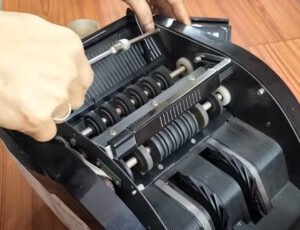
Serviceability. Tool-free access to the transport path, removable sensor covers and a diagnostic screen that names the failing sensor all reduce the minutes per intervention. Over five years those minutes are the difference between a service contract that pays for itself and one that does not.
Part availability commitment. A written commitment to supply parts for a defined number of years after the model is discontinued protects the resale value and prevents a machine from becoming scrap at year four because a $12 roller is unavailable.
Noise and footprint. Less obvious, but real in small cash rooms: a machine that runs at a noise level the staff can tolerate gets used at full speed, and a machine that does not gets run slowly or intermittently, which quietly destroys the throughput case that justified the purchase.
Three buyer profiles, three different answers
The same model produces different conclusions depending on where the machine sits.
| Site type | Monthly volume | Dominant cost line | Priority in specification |
|---|---|---|---|
| Bank or credit union branch | Under 500,000 notes | Labour and service response | Compact footprint, reliable authentication, simple batch presets |
| Retail chain cash office | 500,000 to 3 million notes | Throughput and downtime | Speed at realistic duty cycle, spare parts kit, multi-site service coverage |
| Cash centre or CIT depot | Over 3 million notes | Downtime and compliance | Stacker count, audit records, software update path, redundancy |
A branch that buys on throughput pays for capability it will not use. A cash centre that buys on price pays for it every day the machine is stopped. The site type, not the budget, should decide which line gets the attention in negotiation.
The decision rule
If a purchase decision has to be made with incomplete information, use this order. First, establish monthly volume and the deposit window; those two numbers set the minimum duty-adjusted throughput. Second, count the destinations the workflow needs; that sets the stacker configuration and rules out machines that cannot be expanded. Third, price the five-year service and parts arrangement, including the update policy, rather than the unit alone. Fourth, ask what happens on the day the machine stops, and write the answer into the contract.
Dongbo’s counter range is built around the first two steps: the DB780A with speed settings from 600 to 1,600 notes per minute for higher-volume cash rooms, the DB550 for wholesale and factory environments, and dedicated counterfeit detectors where authentication is the only requirement. The full product listing sets out hopper and stacker capacities side by side, which is where a five-year cost comparison should start.
A machine that costs less on the invoice and more every month afterwards is not cheaper. It is a different payment schedule, and the payments are larger.