
A smart safe promises the most attractive arithmetic in retail cash handling: drop today’s takings into a steel cabinet, let it count and validate the notes, and see the money credited to your account before a courier ever collects it. For cash-heavy operators — convenience stores, fuel stations, QSR chains, pharmacies — the pitch lands close to reality. But the contracts behind these machines vary widely, and the difference between a smart deal and an expensive rental is usually found in four places: counting accuracy, credit terms, service response and data access. This article walks through what a smart safe does, what depositing through one really costs, and what to check before signing.
What a Smart Safe Actually Does
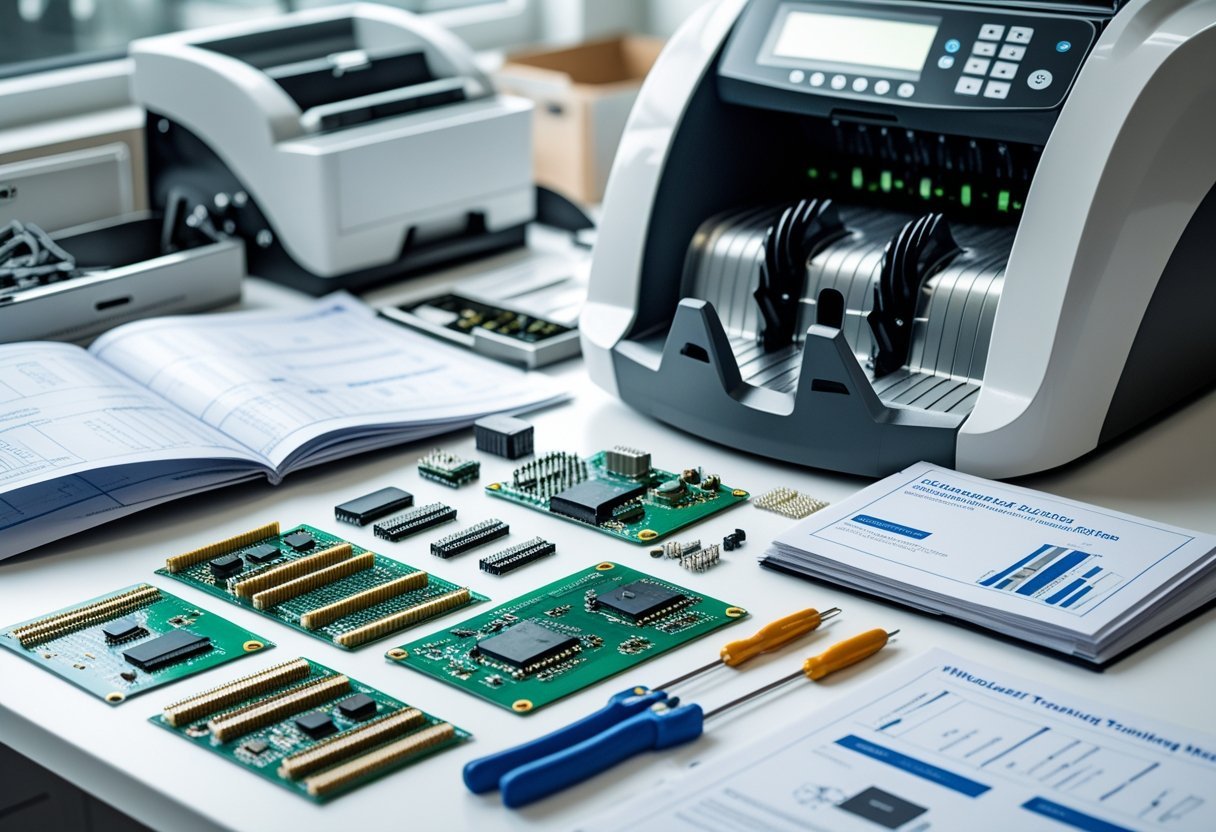
At its core, a smart safe combines three functions that were historically separate. First, it counts and validates notes as staff drop them in, using the same sensor families found in a banknote counter — optical, magnetic and infrared detection against stored currency profiles — so the deposited total is a machine-verified figure rather than a clerk’s estimate. Second, it stores the cash under controlled access, logging every deposit by user, shift and timestamp, which turns the notorious end-of-day cash-up argument into an audit trail. Third, it communicates: the deposit record is transmitted to a bank or processor, which can grant provisional credit based on the reported total before the cash is physically collected.
That last point — provisional credit — is what separates a smart safe from an ordinary night drop. The cash stops being float that sits in your back room and starts being working capital. It also changes who is responsible for the cash: once notes are in the machine, loss exposure shifts toward the service provider and its insurance arrangement, and shrinkage calculations start from the machine’s record rather than from a register drawer.

What a smart safe does not do is equally worth stating. Most units handle notes only — coins still need counting and packaging, which is why coin-intensive retailers run a separate process, weighing it against in-house coin counting versus a counting service. And a smart safe is not a recycler: it does not dispense validated notes back to the till. Operators who need change-giving automation are looking at a different product class, compared in the table near the end of this article.
The Business Case in Numbers
Depositing through a smart safe replaces two cost lines: the bank’s cash handling fee and the labor spent counting, preparing and transporting takings. Both are quantifiable, and published UK figures make the comparison concrete.
PayPoint’s smart safe service for UK convenience retailers charges £170 per month covering the device, weekly cash collection, maintenance and support, plus 30 pence per £100 deposited; by comparison, Lloyds’ standard commercial cash deposit rate is 85 pence per £100. Better Retailing’s calculations put the fee break-even at about £7,133 banked per week — below that, the monthly rental dominates; above it, the per-deposit rate wins decisively. PayPoint itself notes that retailers taking more than £5,000 per week in cash are typically the most attracted to the model.
Table 1: UK example — smart safe service vs standard bank deposit fees
| Item | Smart safe service (PayPoint) | Standard bank deposit (Lloyds) |
|---|---|---|
| Counting / deposit fee | 30p per £100 | 85p per £100 |
| Fixed cost | £170 per month (device, collection, maintenance) | None stated |
| Weekly break-even | ≈ £7,133 banked per week (fee comparison only) | |
Source: Better Retailing, report on the PayPoint smart safe service. Excludes secondary savings (travel, insurance, shrinkage) that would move the break-even lower.
US vendor figures follow the same shape. NationalLink, a smart safe provider, reports that banks typically charge $1.50 to $2.00 per $1,000 to count deposits, while smart safe processing averages about $0.65 per $1,000, with next-business-day provisional credit. These are vendor-reported figures, so treat them as an opening position for your own negotiation rather than a benchmark — but the direction is consistent across markets: per-value processing through automated deposit runs cheaper than counter deposits once volume is meaningful.
There is a third line that never appears in the fee tables but often dominates the business case: labor. Counting and preparing a day’s takings by hand, twice, by two people, at a fully loaded staff cost of $20–30 per hour, can exceed the entire deposit fee structure of the smart safe. The arithmetic differs by store, but the method does not: measure the minutes your staff currently spend on cash-up, price them honestly, and put that number next to the rental.
Accuracy and Note Validation Inside the Safe
The counting module inside a deposit safe is a banknote counter with a transport path and a validation stack, and it inherits every caveat that applies to counters generally. Reconciliation disputes arise the same way they do at the till — when the machine’s total disagrees with the drawer’s count — and the resolution follows the same discipline described in our article on cash variance investigation: a logged, machine-attributed figure, a physical recount procedure, and a record of who touched what.
Validation is where deposit machines earn their fee. Notes dropped in are checked for authenticity, and counterfeits (or notes the machine cannot classify) are returned or segregated rather than passed into the deposit record. That matters commercially: a fake note sitting in a till contaminates your own books, while a fake rejected at the smart safe never becomes the bank’s problem to discover a week later. The same logic that applies to selecting a counter applies here — per-denomination profiles, current currency database, and rejections that name the failed check. Retailers comparing units should run their own acceptance test, exactly as banks do: a known mix of genuine notes and, where legal to obtain for testing, documented counterfeit specimens, processed three times through each candidate machine.
One caution on speed claims: deposit safes count single-note feed slower than open counters, typically a few notes per second, because each note must be validated and recorded individually. That is a feature, not a defect — the bottleneck at the deposit point is usually the person making drops, not the machine — but a high-volume store that imagines teller-counter throughput will be disappointed.
Contract Terms That Decide Whether It Pays Off
Hardware is the visible half of a smart safe deal; the service agreement is where the economics actually live. Five clauses deserve line-by-line attention.
Provisional credit conditions. When is credit granted, up to what amount, and under what conditions can it be reversed? If collection is missed on schedule, does credit continue? A provider that grants credit “up to a limit” can effectively cap your working-capital benefit during your best weeks.
Collection and over-limit behavior. What happens when the safe approaches capacity between scheduled pickups? Some providers charge emergency collection; others simply leave credit capped until the next route. A store that banks £20,000 on Saturdays needs to know before signing.
Service response and downtime. A dead safe becomes a locked vault you cannot deposit into — and provisional credit stops. Look for a defined response time (24–48 hours), a loaner or overflow procedure, and liability language covering the period the machine is down.
Data access and ownership. Deposit logs by user, shift and denomination should be exportable — yours, not held hostage in the provider’s portal. Integration with your POS or back-office accounting saves the manual re-entry that quietly erases the labor savings.
Exit terms. Hardware rental, multi-year terms and termination penalties are common. Establish who owns the machine, what happens to the cash inside at contract end, and how the final reconciliation is performed.
Banks have their own view of this ecosystem — notes recirculated through machines are subject to central bank authentication frameworks (the ECB’s recirculation decision for professional cash handlers is the clearest example), and value in circulation statistics from the Federal Reserve show how much paper remains in daily commerce. In other words, the cash is not going away; the question is only which infrastructure handles it at which cost.
Smart Safe vs Cash Recycler vs Manual Banking
The three approaches to retail deposit handling overlap enough that buyers confuse them, so the comparison below states the differences plainly. The right choice depends on volume, staffing and how fast you need the money back in your account.
Table 2: Smart safe vs cash recycler vs manual banking
| Aspect | Smart safe | Cash recycler | Manual banking |
|---|---|---|---|
| Core function | Counts, validates and stores deposits; transmits records | Accepts and dispenses validated notes to the till | Staff count, prepare and carry takings |
| Cash flow | Provisional credit, typically next business day | Immediate in-store reuse; settlement per arrangement | Credited only after the branch processes the deposit |
| Counterfeit handling | Rejected at the deposit point with reason codes | Validated both directions at the recycler | Depends on teller vigilance |
| Coins | Usually not handled; separate process needed | Models vary; coin recycling is a separate class | Fully manual |
| Typical fit | Cash-heavy single stores and multi-site retail chains | High-transaction tills needing change, e.g. QSR, fuel | Low-volume or mixed-payment businesses |
| Main cost to watch | Rental plus per-deposit fee; contract terms | Higher unit price; service uptime is critical | Labor hours and insurance exposure |
A practical sequencing rule for most operators: if your problem is cash sitting idle and deposit fees, the smart safe addresses it at the lowest hardware cost; if your problem is tills running out of change mid-shift, a cash recycler earns its premium; if neither problem is material, manual banking remains a legitimate answer. And the decision should be revisited whenever volume shifts — the break-even points in Table 1 move with your takings, not with your equipment.
Before signing anything, ask each prospective provider the same five questions in writing: when credit posts and under what limits; what collection over-limit costs; what the service response time is and what compensation applies during downtime; whether deposit data exports are included; and what the exit terms are. A provider that answers all five cleanly will usually operate the same way.