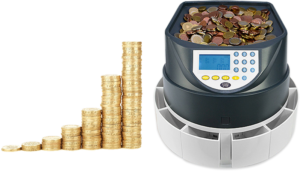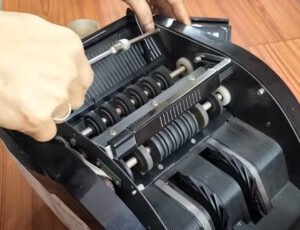
A coin counter is one of the few machines in a cash office that gets judged on a single number. Suppliers quote accuracy figures in the high nineties, buyers write them into purchase orders, and then the machine arrives and starts stopping on a mixed bag of quarters, nickels and a handful of coins that came back from a vending route.
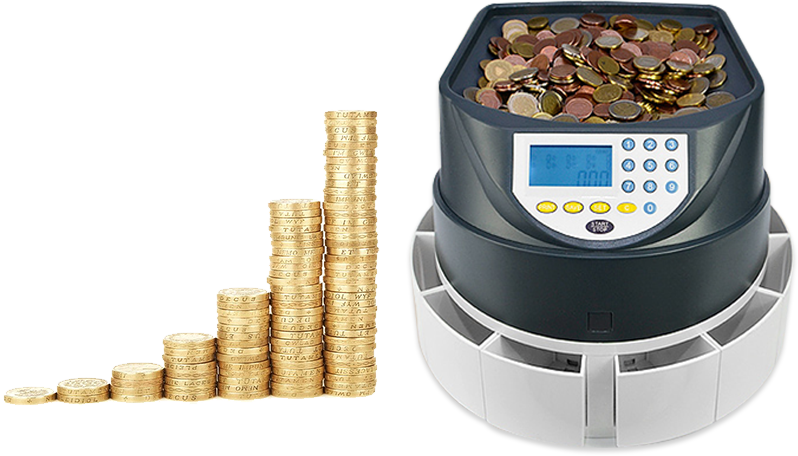
The accuracy figure is not a lie. It is a measurement taken under conditions that rarely exist in the room where the machine is installed. Understanding why coin counters miscount is mostly a matter of understanding what the machine can physically distinguish, and where a real batch of coins falls outside those limits.
Three different failures get called “miscounting”
Before diagnosing anything, separate the three things an operator means when they say the machine is wrong.
The first is a count error: the machine says 1,000 coins and the bag holds 998. This is rare in a working machine and usually traces to a mechanical issue such as a coin riding on top of another coin through the counting sensor.
The second is a denomination error: the machine counts the right number of coins but assigns some of them to the wrong denomination, so the value total is wrong even though the piece count is right. This is the most common complaint in multi-denomination environments, and it is almost always a discrimination problem rather than a counting problem.
The third is a mechanical stop. The machine halts, the display shows an error, and the operator assumes the count is wrong. Usually the count is fine and the machine has correctly refused to process something it could not identify. Confusing a stop with a miscount leads operators to distrust a machine that is doing exactly what it was designed to do.
How a coin machine identifies what it is looking at
Almost every coin counter and sorter uses the same three physical properties, in the same order.
Diameter comes first. Coins travel along a rail or through a channel sized so that only one coin passes at a time, and the coin’s diameter determines where it sits relative to the counting sensor. On a sorter, the rail is stepped: as the channel widens, a coin falls through the first opening it fits. Diameter is the cheapest and fastest discriminator, which is why it carries most of the sorting work.
Thickness comes second, measured as the coin passes a reference gap. Thickness separates coins that share a diameter but differ in height, and it also catches coins travelling two at a time.
Alloy comes third, and it is where modern machines earn their price. An oscillating electromagnetic field induces eddy currents in the coin, and the coin’s response depends on its metal content and on how deeply the current penetrates. A copper-plated zinc cent and a solid copper cent give measurably different responses. So does a steel slug, a brass washer and a genuine quarter. This is the channel that separates a real coin from something made to the same size.
Optical sensing is the fourth channel on better machines, used mostly to confirm a decision rather than make one. A camera can read a coin’s surface pattern, but it struggles with dirty, scratched or corroded coins, which is why optical confirmation sits behind diameter and alloy rather than in front of them.
The dimensions the machine is working with
The margins between denominations are smaller than most operators expect, and it is worth seeing them side by side.
| Denomination | Diameter | Weight | Composition |
|---|---|---|---|
| Cent (penny), 1982 and later | 19.05 mm | 2.500 g | Copper-plated zinc |
| Cent, before 1982 | 19.05 mm | 3.11 g | 95% copper |
| Five cents (nickel) | 21.21 mm | 5.000 g | 75% copper, 25% nickel |
| Ten cents (dime) | 17.91 mm | 2.268 g | Copper-nickel clad |
| Quarter dollar | 24.26 mm | 5.670 g | Copper-nickel clad |
| Half dollar | 30.61 mm | 11.340 g | Copper-nickel clad |
| Dollar coin | 26.49 mm | 8.100 g | Manganese-brass |
Source: United States Mint coin specifications and 31 U.S.C. §5112.
Operations outside the United States work with the same principle and different numbers. The eight euro denominations vary in diameter, thickness, weight, colour and alloy: the 1 and 2 euro coins are bimetal, while the 10, 20 and 50 cent coins are struck in a brass alloy that gives a distinctly different eddy-current response from the copper-nickel pieces. A machine that counts euros needs a profile for each of the eight, and a machine set up for dollars will not count euros correctly no matter how the sensitivity is adjusted.
Look at the first two rows together. A penny and a dime differ in diameter by 1.14 mm and in weight by 0.232 g. Those are narrow margins, and they explain a design decision that shows up in every coin counter: the machine does not rely on weight alone for small coins. A tolerance of a few hundredths of a gram on a 2.5 gram coin is within the range of ordinary wear, dirt and plating variation, so diameter does the primary work and alloy confirms it.
Now look at the penny rows. A pre-1982 copper cent weighs 3.11 grams; a post-1982 zinc cent weighs 2.500 grams. Same diameter, same colour to the eye, 24 percent difference in mass and a completely different electromagnetic signature. A machine calibrated for modern cents will treat a copper cent as an anomaly. Some machines reject it, some count it as a penny but flag the weight, and some, if the calibration is loose, will push it toward the nearest match and get the value wrong.
Where the tolerances collapse in a real batch
Four categories of coin cause most of the trouble, and all four are normal in commercial cash, not exotic.
Pre-1982 copper cents are still in circulation in large numbers in the United States. Any operation counting mixed-age pennies will see them, and any machine tuned only on new cents will produce rejects or weight flags. The fix is a denomination profile that accepts both compositions, which is a firmware setting, not a hardware upgrade. Buyers should ask whether the profile exists before purchase rather than discovering it afterwards.
Foreign coins are the single largest source of stops in border regions, tourist areas and transport hubs. A Canadian cent is 19.05 mm in diameter and 2.35 grams, close enough to a US cent that diameter alone will not separate them. Alloy sensing usually will, and that is the argument for eddy-current detection over diameter-only sorting. Where the machine cannot separate them, the correct outcome is a reject, not a guess. The euro area handles the same problem from the other direction: coins circulate freely across member states, and the range of euro coin types includes commemorative and national variants that look different but share the same specifications, so appearance cannot be used as a discrimination channel.
Damaged and deformed coins include bent coins, coins with rolled edges, coins crushed by machinery and coins with drilled holes. A bent coin changes its effective diameter and can jam a rail; a coin with a hole changes its eddy-current response. Both should end up in the reject cup, and a machine that keeps trying to process them is a machine that will eventually damage its own transport.
Non-coin objects are the category operators underestimate: washers, tokens, game pieces, button batteries, screws. A brass washer of the right diameter will pass a diameter test and fail an alloy test. A steel washer may pass both a diameter and a thickness test on a cheap machine and fail only on alloy. This is the practical difference between a counter with two sensing channels and one with three or four.
Bag stops are not errors
Many “miscounting” reports turn out to be batch presets working as intended. Operators set a batch of 50 or 100 coins so that coins can be bagged in fixed quantities, forget the setting, and then interpret the stop as a fault.
The same applies to hopper-empty stops, which on most machines pause the count rather than end it. The displayed number is the count so far, not the count of the batch. Training staff to read the batch indicator separately from the total eliminates a surprising share of support calls.
Diagnosing a real error
Once batch stops and foreign objects are ruled out, the remaining causes fall into a small set. The table below maps the symptom to the likely cause and the first thing to check.
| Symptom | Likely cause | First check |
|---|---|---|
| Count consistently short by a small number | Coins riding through the sensor in pairs, or a worn exit gate releasing late | Run a known 500-coin bag three times; if the shortfall repeats, inspect the gate and the counting sensor window |
| Correct count, wrong value | Denomination profile mismatch, usually small-denomination confusion | Check which denomination is over- or under-counted in the value breakdown, then verify the profile for that pair |
| Stops every few hundred coins | Foreign coin, bent coin or debris in the rail | Empty the reject cup and inspect the rail under a light for a coin fragment |
| Rejects a specific coin type repeatedly | Tolerance set too tight for that composition, for example copper cents | Test five known coins of that type; if all reject, the profile needs widening |
| Drifting value totals over a shift | Dust on the alloy sensor or thermal drift in the sensing circuit | Clean the sensor window, let the machine stabilise, then re-run the reference bag |
| Coins jam at the hopper | Overfilling beyond hopper capacity, or mixed diameters fed too fast | Reduce the load to the rated hopper capacity and feed in smaller batches |
Two of those rows are worth expanding. Sensor dust is cumulative and invisible: a film of coin dust on an optical or eddy-current window shifts readings gradually, so the machine does not fail suddenly, it drifts. Operations that clean the sensing area at a fixed interval in coins processed, rather than when someone remembers, report far fewer value discrepancies.
Thermal drift works the same way. A machine moved from a cold delivery bay into a warm cash office can read consistently low for the first hour while its sensing circuit stabilises. The fix is to let the machine sit at room temperature before the first reconciliation, not to recalibrate it immediately.
What the accuracy claim should mean
An accuracy figure is only meaningful alongside the test conditions: coin mix, condition, speed and number of passes. A supplier quoting 99.9 percent on new coins at reduced speed is telling the truth about a scenario that will not occur in a supermarket cash office.
The practical response is to test on arrival, with your own coins. Build a reference batch of 5,000 to 10,000 coins with a known composition, including the awkward items: copper cents, a few foreign coins, a bent coin, a washer. Run it three times at the speed you intend to use, and record the count, the value and the reject count each time. A machine that reproduces the same result three times is a machine whose behaviour you can plan around, even if the number is not perfect.
Then repeat the test at the end of the first month, after the machine has processed production volume. The difference between the first run and the second tells you more about build quality than any datasheet.
Where machine class changes the answer
Counted coin does not stay in the building. In the United States it moves from the retailer to a depository institution and then, in many cases, through coin terminals operated by armored carriers on behalf of the Federal Reserve Banks. That chain is why bag integrity and bag weight matter as much as the count on the display: a bag that reconciles to a piece count but arrives light by a few coins creates a discrepancy that follows the deposit all the way back to the cash office that filled it.
Not every coin operation needs the same machine. A retail back office counting a few thousand coins a day needs a counter with reliable diameter and alloy sensing, a reject cup and a batch preset. A bank branch or a cash-in-transit depot that sorts mixed denominations into separate outputs needs a sorter, with one output per denomination and a reject path for everything else.
Dongbo builds both types. The DB380, for example, counts at up to 330 coins per minute with a hopper rated for 300 to 500 pieces and an RS232 port for a thermal printer, which is the configuration most retail and branch operations settle on. Higher-volume sorting work is covered by the DB350 series, and the full range is listed on the products page.
What matters across all of them is the same: the number of sensing channels, whether denomination profiles can be edited on site, and whether the reject path is genuinely separate from the counted output. Those three answers determine whether the machine will still be accurate in year three, when the coin mix has drifted and the novelty coins have arrived.
Questions buyers ask before signing
Does the machine need to be calibrated for each currency? Yes. Diameter, thickness and alloy profiles are currency-specific, and a machine set up for one currency will not count another correctly without a profile for it.
Can it handle mixed denominations in one pass? Only if it is a sorter with separate outputs, or a counter with value-counting software and reliable denomination discrimination. A basic counter will total pieces, not value.
Why does it reject coins that look fine? Usually because the coin is outside the profile on one channel: wrong alloy, wrong weight, or a defect that is not visible. The reject is the correct behaviour, and the question to ask is which channel triggered it.
How often should the sensing area be cleaned? In most commercial settings, at an interval measured in coins processed rather than calendar time. A busy site may need it weekly; a quiet one monthly. The manual gives a figure, and the real interval is usually shorter.
Is a counter or a sorter the better buy? If the output is a single bag of mixed coins going to a bank, a counter is enough. If the output is separate denomination bags that must reconcile individually, a sorter pays for itself in labour within the first year.
What does the reject rate tell me? A rising reject rate on a stable coin mix is the earliest warning of sensor contamination or transport wear. Track it weekly and it becomes a maintenance trigger rather than a mystery.