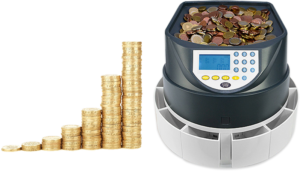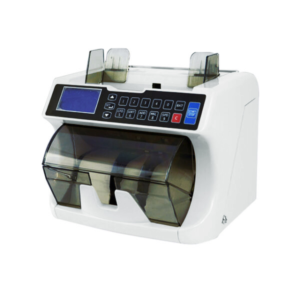
A cash office is not a room with a counting machine in it. It is a short production line, usually four to six metres long, that has to turn a messy inflow of sealed bags into verified, strapped, documented deposits before the cut-off time. When that line is designed badly, the cost does not appear as a capital expense. It appears as overtime, as end-of-day queues, as a discrepancy investigation that consumes two people for a morning, and as a machine that spends its life being reloaded instead of counting.
This guide is written for the people who actually specify these rooms: operations managers in retail groups, branch services teams in banks, and equipment buyers at cash processing companies. It covers zoning, equipment classes, a sizing model you can defend in a budget meeting, and the layout details that are cheap now and expensive later.

Size for the peak day, never the average day
Almost every under-performing cash office was sized on an annual or monthly average. The arithmetic looked fine: total volume divided by working days, divided by machine speed, equals a comfortable number of hours. The problem is that cash does not arrive evenly. It arrives in a shape defined by the business: Friday and Saturday for retail, the first and last days of the month for utilities and benefit payments, payroll weeks for payroll processors, and the days after a public holiday for everything.
Two ratios matter more than the annual total:
- Peak-to-average ratio. Divide the busiest day’s note volume by the average day. In grocery retail this often lands between 1.6 and 2.0; in convenience and fuel it can be higher because weekend trade dominates. Month-end effects add a second layer on top.
- Arrival concentration. Bags rarely trickle in. They come in a convoy after the last collection of the day, which means the office must clear a full day’s volume inside a two- or three-hour window, not eight.
If you size to the average and staff to the average, you are guaranteeing that the peak day is handled by tired people working under time pressure. That is exactly the condition in which miscounts and unrecorded adjustments happen.
What the payment data actually says about cash volume
Buyers are often asked to justify cash equipment investment at a time when every headline says cash is disappearing. The honest answer is more specific: cash’s share of transactions is falling, while absolute note volumes handled by institutions remain large, and the handling cost per note has not fallen with it.
The European Central Bank’s SPACE study is the most consistent series available for consumer payment behaviour at the point of sale in the euro area. The direction is clear, and so is the remaining weight of cash.
| Year | Cash share, number of POS transactions | Cash share, value of POS transactions |
|---|---|---|
| 2019 | 72% | 47% |
| 2022 | 59% | 42% |
| 2024 | 52% | 39% |
Source: ECB, Study on the payment attitudes of consumers in the euro area (SPACE) 2024. The 2019 comparison figures are the ones the ECB itself cites when describing the 2019–2024 change.
Read the table the way an operations planner reads it. The number of cash transactions fell by roughly a fifth between 2019 and 2024, but it did not fall to zero, and cash remained the single most frequent instrument at the counter. Meanwhile the notes that do arrive still have to be counted, authenticated, sorted for fitness, strapped, bagged and reconciled. A 20% drop in volume does not remove a workstream; it removes some hours from it.
The United States tells a similar story from the issuing side, and the numbers are worth having in front of you when someone argues that the equipment question is settled.
| Year | Notes paid out (billions of pieces) | Value paid out (USD billions) | Currency in circulation at year end (USD billions) |
|---|---|---|---|
| 2023 | 30.9 | 797.0 | 2,297.4 |
| 2024 | 30.6 | 799.0 | 2,322.9 |
| 2025 | 29.8 | 826.5 | 2,394.9 |
Sources: Payments of Currency to Circulation: Volume and Currency in Circulation: Value, Board of Governors of the Federal Reserve System.
Note the direction: fewer notes paid out in 2025 than in 2023, but a higher value, and a larger stock of currency outside the central bank. Higher-value notes mean more $100s in the flow, and $100s are exactly the notes that attract counterfeits and therefore the ones that need authentication rather than simple counting. This is why the equipment conversation in 2026 is rarely about raw speed alone.
Divide the room into four zones before choosing a single machine
Equipment selection follows layout, not the other way round. A cash office needs an unbroken forward flow of material and a strict separation between dirty inflow, verified value and outgoing consignment. Four zones cover it.
1. Receipt and unbagging
This is where sealed bags are logged in against the manifest, weighed if the procedure calls for it, opened, and emptied into trays. It needs a stainless or laminate bench with a lip, bins for packaging waste, a scale, a barcode reader for bag IDs, and a terminal. It does not need a counting machine, and putting one there is a common mistake: it splits the verification step away from the reconciliation step and creates two places where notes can sit unattended.
2. Verification and counting
The production heart of the room: one bench per operator, machine at elbow height, reject tray within reach, screen angled to the operator and to the camera. Notes arrive in banked trays, are counted and authenticated, and leave either as verified value or as a reject/suspect pile that goes to a second, slower review. In offices handling mixed currencies, this zone also needs a clear physical separation for each currency, because mixed-currency trays are the single most reliable way to produce phantom discrepancies.
3. Reconciliation, strapping and sealing
Counts become records here: strapping into standard bundles, printing a count slip or exporting a file, matching against the manifest, resolving differences, and sealing outgoing consignment bags with numbered tamper-evident seals. This zone needs the printer, the seal register, and the person who is allowed to sign off. Keep it separate from the counting bench so that the person sealing is not the person who counted without a second signature.
4. Secure storage and dispatch
Vault or safe, trolley route to the vehicle bay, and a door that does not open onto the customer area. The design question is corridor width and turning radius: a loaded trolley needs 1,000–1,200 mm of clear width, and a route that crosses a public or staff corridor is an audit finding waiting to happen.
The rule that ties the four zones together is simple: material moves forward, never back. Any layout that requires verified value to pass through the unbagging area again has created a place where two custody states occupy the same square metre.
Equipment classes, and what each one is actually deciding
Suppliers use overlapping names for different machines. It helps to classify by what the machine decides, not by what it is called.
| Class | What it decides | Typical published performance | Where it belongs |
|---|---|---|---|
| Note counter, single denomination | How many notes are in this stack; whether any are suspect | 600–1,600 notes/min depending on the model and mode | Branch counters, retail back offices, pay offices |
| Note counter with value counting | Total value of a mixed stack; per-denomination counts | Usually lower than pure counting speed; multi-currency profiles | Bureaux, hospitality, multi-currency retail |
| Sorter (fitness and authentication) | Which notes are fit to recirculate, which are suspect, which are unfit | Typically 600–1,200 notes/min with 3–4 output pockets | Cash centres, larger branches, CIT processing |
| Coin counter | How many coins, by denomination or in total | Roughly 300–2,300 coins/min across the market | Retail, transport, vending, small branches |
| Coin sorter with bagging | Denomination split, bag fill levels, batch totals | Multi-pocket, often with RS-232 or printer output | Cash centres, casino cages, lottery operators |
| Standalone detector | Whether a single note is genuine, without counting | UV, magnetic, IR and size checks in various combinations | Front counters, market traders, taxis, small retail |
Performance ranges refer to figures published in manufacturers’ datasheets, including the DB3000 series (four speed levels from 800 to 1,500 notes/min, 500-note hopper, 200-note stacker, 100-note reject pocket) and the DB780A series. Treat them as class boundaries, not as guarantees of your throughput.
The distinction buyers most often get wrong is between counting and sorting. A counter tells you how much is there. A sorter tells you what may go back out into circulation. Under the Eurosystem framework, machines used for recirculation must be tested against defined thresholds and produce at least four distinct outcomes: rejected, suspect counterfeit, genuine but unfit, and fit. A single-pocket counter cannot do that job, no matter how fast it counts. The Eurosystem test procedure sets out the categories and the pass criteria.
For most retail back offices, the practical answer is one value-counting machine with solid authentication plus, where volume justifies it, a coin sorter. For a cash centre or a bank’s central processing unit, the answer is sorter-class equipment, because the decision about fitness is the whole point.

A sizing model you can defend in a budget meeting
Machine speed is a laboratory number. What you need is an estimate of hours, and hours come from three multipliers applied to rated speed: utilisation, pass structure, and peak factor. Here is a worked example for a retail group’s regional cash office handling 320 sealed bags a day.
Assumptions (state them explicitly in any internal paper; they are the part a finance reviewer will challenge):
- Average 180 notes per bag, single currency, mixed denominations
- Rated counting speed 1,000 notes/min; sustainable utilisation 55% of rated speed, which accounts for hopper reloads, reject clearing, bag handling and operator pauses
- Pass structure 1.10: one primary pass, plus 8% of volume re-counted from the reject pocket, plus a 2% audit sample re-counted on a second machine
- Peak factor 1.7 on the busiest weekday; 2.2 at month-end
- Coin volume 18,000 coins a day, sorted on one machine rated 330 coins/min at 50% utilisation
| Line item | Normal day | Busiest weekday | Month-end |
|---|---|---|---|
| Bags received | 320 | 544 | 704 |
| Notes to count | 57,600 | 97,920 | 126,720 |
| Note-passes at 1.10 | 63,360 | 107,712 | 139,392 |
| Effective rate per machine (55% of 1,000) | 550/min | 550/min | 550/min |
| Note hours, one machine | 1.9 h | 3.3 h | 4.2 h |
| Note hours, two machines in parallel | 1.0 h | 1.6 h | 2.1 h |
| Coins to sort, at 165 coins/min effective | 1.8 h | 3.1 h | 4.0 h |
| Operators required on the busiest shift | 2 | 3 | 3 |
Model, not measurement. Coin hours assume the coin stream runs on a separate machine and a separate operator; if one person alternates between note and coin work, the hours add and the effective rates fall.
Three conclusions usually fall out of this kind of table. First, two mid-range machines beat one high-speed machine, because the second machine provides redundancy on the day the first one jams. Second, the peak day, not the average, decides the staffing plan. Third, coin work is not a rounding error: at typical sorting speeds it can consume as many hours as the note stream, and it is almost always the task that gets deferred to the end of the day.
Run the same table with your own volumes before you talk to a supplier. If a vendor’s proposal cannot reproduce your arithmetic, the proposal is marketing.
The five constraints that decide real throughput
Rated speed is measured with a dedicated feeder and a clean stack. Your room does not have either. Five constraints eat the difference, and each has a design fix.
Hopper capacity versus rate
Arithmetic first: at 1,000 notes/min, a 500-note hopper empties in 30 seconds. Even at a realistic 550 notes/min effective, a full hopper lasts under a minute. If one operator both loads and monitors, the machine spends a meaningful share of its life waiting. The fixes are a second operator feeding, a larger hopper, or accepting a lower effective rate in your plan. Do not accept a plan that assumes continuous rated speed with a single operator.
Reject pocket capacity
A 100-note reject pocket at an 8% reject rate on 1,000 notes/min fills in about 75 seconds of running. Reject handling is not an exception path; it is a continuous task. Position the reject tray so it can be emptied with one hand without standing up, and plan the re-count as part of the pass structure, as in the model above.
Bag and strap changes
Strapping, banding and bag changes are manual, and they scale with the number of bundles, not with the number of notes. A bag of 180 mixed notes at an average value that produces several bundles per bag will trigger more handling events than the note count suggests. Standardising bundle sizes across sites is one of the few process changes that reliably buys back minutes.
Operator attention
Counting is monotonous and the error rate rises with continuous exposure. Two operators rotating between counting, sealing and reconciliation every 45–60 minutes will produce fewer errors than one operator working a three-hour block. This is a staffing decision that belongs in the layout: if the benches are arranged so that people cannot easily swap positions, rotation will not happen.
Authentication stops
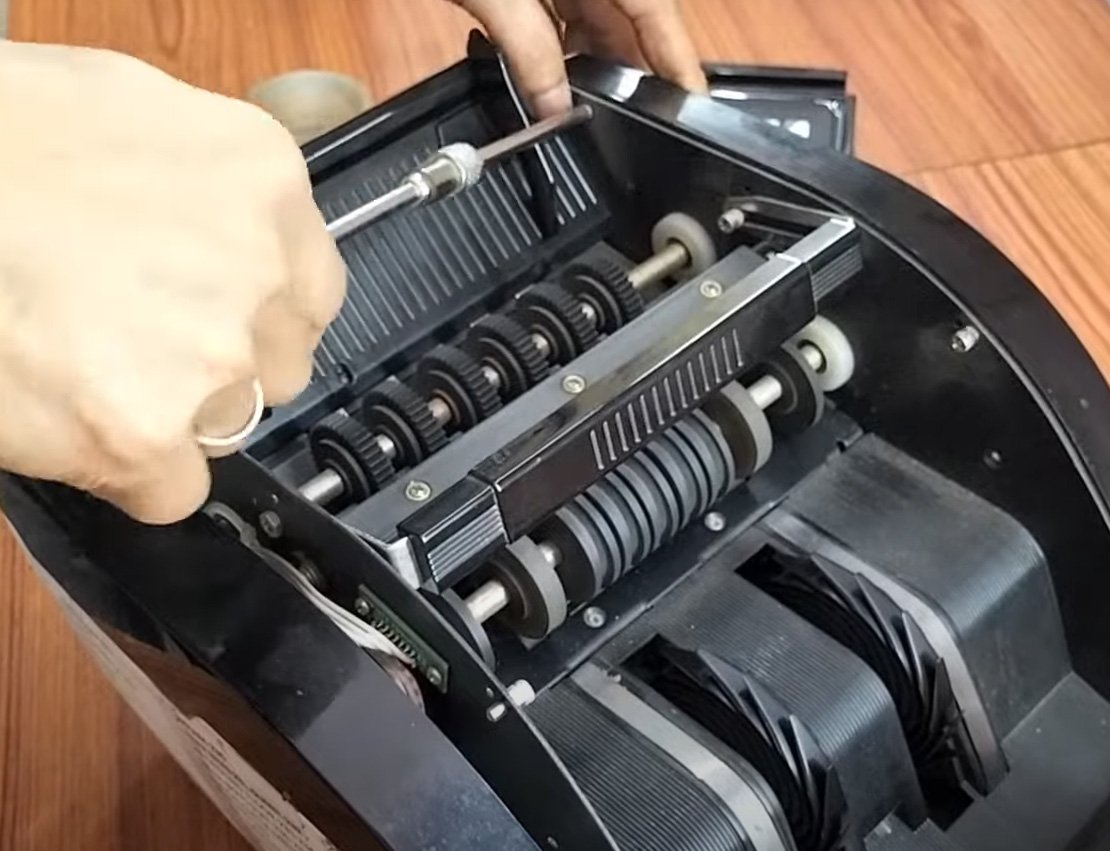
Every suspect note stops the flow. On a machine with magnetic and infrared checks, a worn but genuine note can trigger a stop, and each stop costs tens of seconds plus a judgement call. That is why a second, simpler detector at the review bench is worth having: it lets the operator resolve a suspect quickly instead of restarting a batch.
Layout details that are cheap now and expensive later
These items cost almost nothing at fit-out and a great deal afterwards.
- Bench height. 750–900 mm to the working surface, with the machine raised so the note path sits at forearm height. Operators who stoop to feed a hopper lose speed within an hour and complain about their backs within a month.
- Clearance. At least 900 mm behind the operator, 1,200 mm where a trolley must pass. A bench against a wall with 600 mm of space looks efficient on a plan and is unusable in practice.
- Power and data. A dedicated circuit per bench, surge protection, and a UPS on at least the reconciliation terminal. Machines with RS-232 or USB output need the cable route designed, not stapled along the floor.
- Noise. Counters run in the 65–75 dB(A) range in continuous operation. In a small room with hard surfaces, two machines plus a coin sorter is a genuinely uncomfortable workplace. Acoustic ceiling tiles and a rubber mat under each machine are inexpensive.
- Lighting and cameras. Shadow-free light over the counting surface, and a camera angle that captures both the note path and the machine display. If the camera cannot see the count, the recording proves nothing.
- Waste and packaging. Bags, seals and packaging generate volume. A bin under the unbagging bench, emptied on a schedule, prevents the accumulation that turns a clean room into a cluttered one by mid-afternoon.
Controls belong in the drawing, not in the policy manual
Separation of duties is easy to write and hard to enforce in a room with one bench. The layout should make the control the path of least resistance.
- Counting and sealing at separate positions, with the seal register physically at the sealing position.
- Dual control for opening incoming consignments above a defined value threshold, with both signatures captured on the same record.
- Numbered tamper-evident seals logged at issue and at use, so a missing seal is visible rather than inferred.
- A discrepancy log that records the bag ID, the manifest figure, the counted figure and the resolution, kept where the next shift can see it.
- Camera coverage of the counting surface, the seal register and the door, retained for the period your auditors expect.
The equipment side of this is straightforward: choose machines whose count output can be printed or exported with a timestamp, because a printed slip attached to the bag is still the strongest evidence in a dispute that surfaces three days later. If you are also establishing what certification and machine-testing evidence to demand from suppliers, the checklist in our guide to cash handling equipment certification covers the documents that matter.
Matching equipment to staff, not replacing them
Cash office automation rarely removes a role; it changes the mix. The hours released by faster counting are usually absorbed by reconciliation, exception handling and reporting, which are the tasks that were previously rushed. A realistic business case therefore compares two things: the cost of the hours currently spent on manual counting and re-counting, and the cost of the equipment over its service life, including consumables, maintenance and the spare-parts horizon.
For labour cost, use your own payroll data rather than an industry average. As a reference point, the US Bureau of Labor Statistics put the median hourly wage for tellers at USD 17.62 in May 2024, before benefits and employer costs. In markets where cash office staff are paid close to that level, a machine that removes two hours of counting a day pays back faster than intuition suggests; where labour is cheaper, the case has to rest on accuracy, audit trail and error reduction instead. Both cases are legitimate, but they are different arguments.
One more factor belongs in the comparison: the cost of a counting error. A short bag discovered at the central cash centre triggers an investigation, a charge from the CIT provider, and in retail a shrink case against a store. A single unresolved discrepancy per month can exceed the annual maintenance cost of the machine that would have prevented it.
Procurement checklist
Use this as a scoring sheet rather than a shopping list. Each line should have an owner and an evidence requirement.
- Peak volumes, in writing. Average, busiest weekday and month-end note and coin volumes, with the arrival window in hours.
- Currency set and expected growth. Which currencies, how many, and whether value counting or mixed-batch handling is required.
- Required decisions. Count only, count plus authenticate, or sort for fitness. Be explicit, because this determines the machine class.
- Output and audit trail. Printed slip, file export, both; timestamp and operator ID fields.
- Throughput evidence. Ask for a demonstration using your own notes, at your own mix, with the reject rate recorded.
- Accuracy acceptance test. A defined sample (for example 10,000 notes with a known composition), three runs, an agreed pass threshold, and a remedy if the threshold is missed.
- Authentication performance. Which sensors, tested against which reference notes, and how the machine behaves on worn genuine notes.
- Physical fit. Footprint, weight, bench height, noise level, hopper and stacker capacity against your reload cycle.
- Service and spares. Response time, local presence, and a written spare-parts availability period after end of production.
- Consumables and wear parts. Rollers, belts and sensors, with part numbers and prices, so the five-year cost is visible.
- Certification. CE or FCC as applicable, plus machine-test evidence if the machine will be used for recirculation.
- Training and documentation. Operator training, a maintenance schedule, and a manual in a language your staff read.
- OEM and branding options. For distributors: housing colour, label, packaging and firmware language.
- Reference sites. Two operators of similar size and profile, ideally in your region.
Dongbo builds note counters, coin counters and sorters, detectors and cheque printers for banks, retail groups and distributors, and supplies them with the specification sheets and test documentation this checklist asks for. If you are at the stage of comparing classes of machine rather than brands, the product range is organised by function, and the DB380 coin counter and sorter is a useful reference point for what a mid-volume coin station looks like in practice.
A cash office designed around these numbers will not be the cheapest room in the building. It will, however, be the one that closes on time on the last day of the month, and the one whose counts survive an audit without a second visit.