Two coin counters can carry the same speed figure and behave nothing alike on a cash desk. The number that decides how a working day actually goes is not the one printed largest on the specification sheet. It is how often the machine stops and waits for someone to empty it.
This matters because coin counting is still a routine, high-volume task. In the euro area alone, more than 150 billion coins are in circulation according to the European Central Bank, and cash still accounts for about 14 per cent of consumer payments in the United States, roughly one in five in-person payments, based on the Federal Reserve’s 2026 Diary of Consumer Payment Choice covering 2025. Every one of those coins passes through a counting device somewhere: a bank branch, an armoured carrier, a supermarket back office, a vending operator’s depot.
What follows is a practical way to read speed ratings on coin counting equipment, using the published specifications of the DB series as the worked example. No ranking claims, no estimates dressed up as measurements — just the arithmetic that the specification sheet leaves for the buyer to do.

What a coins-per-minute figure actually measures
Take the DB350 coin counter and its published line item: counting speed up to 330 pieces per minute, maximum. The same figure appears on the DB350B, DB360, DB360SL, DB380 and 350S sheets, which share the same hopper and receiving-cup capacities. The DB450 is rated at 600 pieces per minute.
Three words in that line carry most of the meaning. “Up to” and “maximum” tell you it is a ceiling. The absence of a stated test condition tells you the ceiling was measured under favourable input — in practice, a single denomination, coins in reasonable condition, and uninterrupted feed.
That is not a shortcoming peculiar to one supplier. Speed ceilings are useful because they bound the mechanism: 330 pieces per minute means 5.5 coins a second through the counting track, and 600 means 10. What a ceiling cannot tell you is how much of the working day the machine spends at that figure rather than sitting full and waiting.
Three capacities, three different interruptions
A coin counter has three buffers, and each one ends in an event that stops production for a measurable time:
The hopper holds coins waiting to be counted. When it empties, someone has to pour in another load. On the DB350 family the hopper holds 300 to 500 pieces; on the DB450 it holds 1,000 to 1,300.
The receiving cup or drawer holds coins already counted. When it fills, the machine has to stop, the cup is emptied into a bag, and counting resumes. The DB350 family holds 80 to 150 pieces; the DB450 holds 180 to 230.
The batch preset is a deliberate stop at a chosen count so that coins can be bagged in standard quantities. It is a feature, not a limit, but it is still an interruption in the count.
Divide each capacity by the rated speed and the interruption intervals fall out directly. The table below is arithmetic on published figures, not a measurement.
| Model group | Hopper capacity | Receiving cup | Rated speed | Hopper empties in | Cup fills in |
|---|---|---|---|---|---|
| DB350 / DB350B / DB360 / DB360SL / DB380 / 350S | 300–500 pcs | 80–150 pcs | 330 pcs/min | 55–91 s | 15–27 s |
| DB450 | 1,000–1,300 pcs | 180–230 pcs | 600 pcs/min | 100–130 s | 18–23 s |
The second-to-last column is the comfortable one. Even at a 500-piece load, a DB350 runs for under a minute and a half before it needs more coins. The last column is the one that governs the operator’s day, and it is short on both machines.
The interval that governs the day: cup fill time
At 330 coins per minute, an 80-piece cup is full after roughly 14.5 seconds and a 150-piece cup after roughly 27 seconds. The DB450, running at 600 per minute, fills its 180 to 230 piece cup in 18 to 23 seconds. The engineers who balanced these designs paired a larger cup with the higher speed, so the ratio stays roughly constant. Faster counting does not buy proportionally longer runs between stops.
That is why the honest way to compare the two is an effective rate rather than a rated one. The count only runs while the cup has room. Once it fills, the machine stops while the cup is emptied and returned. A simple model makes the effect visible:
Effective rate (coins per minute) = cup capacity ÷ (cup capacity ÷ rated speed + handling time)
With a handling time of six seconds to empty the cup and put it back — a reasonable assumption for a pull-out drawer with a bag beneath, and one the buyer should replace with their own measurement — the outcomes are:
| Scenario | Rated speed | Effective rate (6 s handling) | Share of rating |
|---|---|---|---|
| DB350, 150-piece cup | 330 | about 271 coins/min | 82% |
| DB350, 80-piece cup | 330 | about 234 coins/min | 71% |
| DB450, 230-piece cup | 600 | about 476 coins/min | 79% |
| DB450, 180-piece cup | 600 | about 450 coins/min | 75% |
Two conclusions follow. First, the cup, not the hopper, is the binding constraint whenever coins are fed at or near the rated speed. Second, the gap between 330 and 600 narrows only slightly in real use — about 1.8 times rated becomes about 1.75 times effective — so the smaller machine is not as far behind as the headline numbers suggest, and the larger one is not a substitute for a well-organised workstation.
Worked example: what 50,000 coins costs in machine time
Planning conversations go better with a number attached. The table below converts daily volume into counting minutes at the rated speed and at the effective rate of about 271 coins per minute modelled above. It assumes a single denomination per pass and does not include sorting, bagging, reconciliation or shift changes.
| Coins per day (one denomination) | Time at 330/min | Time at 271/min effective | Added by cup stops |
|---|---|---|---|
| 10,000 | 30.3 min | 36.9 min | +6.6 min |
| 25,000 | 75.8 min | 92.3 min | +16.5 min |
| 50,000 | 151.5 min | 184.5 min | +33.0 min |
| 100,000 | 303.0 min | 369.0 min | +66.0 min |
At 50,000 coins a day, the difference between the ceiling and the working rate is half an hour of machine time. That is the number worth putting in a business case, because it is the one that repeats every working day. And on top of it sits everything the model deliberately excludes.
Where throughput disappears in a real cash room
Coin mix. Bulk coin is not a random sample of the currency. In the euro area, the one, two and five cent coins made up 64.1 per cent of the number of coins in circulation at the end of 2017, against 6.7 per cent of the value, according to the ECB’s Economic Bulletin. Small coins are the lightest and the most awkward to feed, and they dominate the coin counts that equipment is bought to handle.
Coin condition. Bent, sticky, corroded or wet coins cause double feeds and rejects. Each reject is a stop. Equipment designed for single-piece feed handles this better than equipment designed for speed, and no speed rating survives a bag of coins recovered from a car park.
Mixed input. Capacity figures are quoted per pass. If coin arrives unsorted, either the work is pre-sorted by hand or a machine that separates by diameter is needed — and that requirement belongs in the specification, not in an assumption about what the words “coin counter” imply.
Bag handling and weight. A 1,000-coin bag is not a light object. At the published euro coin specifications, a €2 coin weighs 8.50 g, so 1,000 of them weigh 8.5 kg, and a 1,000-coin bag of 1 cent coins weighs 2.3 kg. Bag weight drives workstation design, manual handling rules and how often an operator can lift without a break — all of which reduce the number of minutes actually available for counting.
Reconciliation and dual control. In bank and cash-in-transit environments the count is usually witnessed and recorded. The RS232 port for a thermal printer on these models exists for that purpose: a printed batch record replaces a handwritten tally. The time this adds is real and belongs in the plan.
Duty cycle: what continuous operation means for a 45 to 50 W machine
Power draw is a poor proxy for endurance. A DB350 is rated at 45 W maximum and a DB450 at 50 W, both from AC 220 V/50 Hz or AC 110 V/60 Hz supplies (the DB450 accepts 110–240 V, 50/60 Hz). At those levels, heat is not the limiting factor; mechanical wear is.
The parts that wear are the ones in contact with coins: the friction wheel that picks coins from the hopper, the belt that carries them past the sensor, and the sensor window itself. Dust from coin surfaces accumulates on the counting track and on the sensor, and the first symptom is usually a rising reject rate rather than a slower count. A machine that is cleaned on a schedule counts at its rated speed for years; one that is cleaned when it fails does not. The cleaning procedure for the components involved is set out in our note on cleaning and maintenance of currency counter components, and it applies to coin handling equipment in the same way.
When specifying duty cycle, ask for two figures rather than one: the recommended continuous running time, and the mean time to clear a jam with the tools supplied. The second is the number that decides whether a two-operator cash office needs a third machine.
When the larger hopper is worth paying for
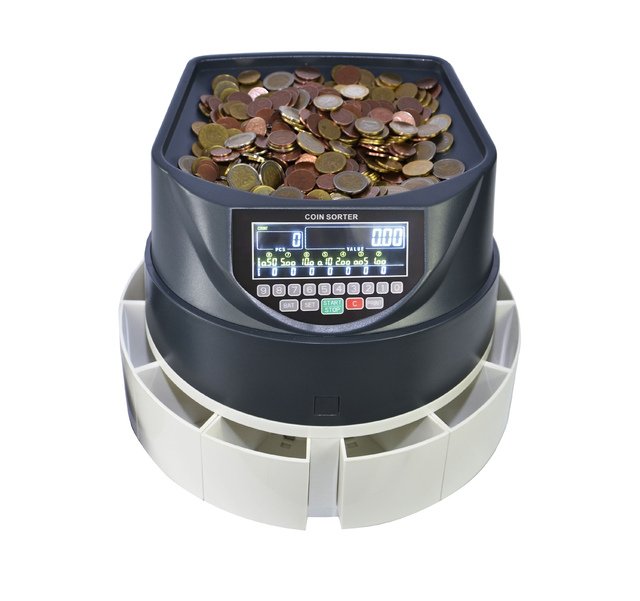
The argument for a 1,000 to 1,300 piece hopper is not speed. It is the removal of reload events from the middle of a batch. On the smaller family, a 500-piece load empties in about 91 seconds at rated speed, which means a 5,000-coin job is interrupted ten times for reloading before any cup stops are counted. On the DB450, the same job needs four or five loads.
Fewer reloads matter most where labour is the constraint: a single operator covering a counter and a phone, or a cash office where the second person is the witness rather than a spare pair of hands. They matter least in a high-volume cash centre where coin arrives in bulk and dedicated operators feed machines continuously, because there a reload is a routine movement rather than a change of task.
What the larger hopper does not fix is the cup interval, which stays between 18 and 23 seconds at rated speed. If the objective is genuinely uninterrupted running, the specification has to address the output side — a bag holder under the cup, a larger receiving drawer, or a machine that discharges into a bag directly. That is a workstation decision as much as an equipment decision.
Acceptance testing: verify capacity before you sign
Speed ratings are easy to test and rarely tested. A short protocol at incoming inspection turns a claim into a measurement, and it takes under an hour:
1. Single denomination, known count. Weigh or pre-count 1,000 coins of one denomination. Run them and time the pass. Repeat three times. Divide 1,000 by the average time in minutes to get coins per minute, then compare with the rated figure.
2. Cup and hopper behaviour. Note how many coins the cup actually holds before the machine stops, and how long an emptying cycle takes with the operator who will do the job. Both numbers feed the effective-rate formula above.
3. Accuracy. Compare the displayed count with the known count on all three runs. A single miscount on clean coins is a defect; on mixed or worn coins it is a finding to record.
4. Deliberate stress. Run 200 coins that include bent, foreign and heavily soiled pieces. Record rejects, jams and recovery time. This is the run that predicts next year’s support calls.
5. Document the result. Record model, serial number, denomination, coin condition, counts and times. A documented baseline is what makes a warranty claim about throughput possible later.
What to put in the RFQ
Most coin counter specifications fail not because the buyer chose the wrong model but because the enquiry asked for a speed and a price. The table below lists the items that determine whether the machine matches the job.
| Item to specify | What to ask for | Why it decides the outcome |
|---|---|---|
| Rated speed | The figure, plus the denomination and coin condition it was measured on | A ceiling without conditions cannot be compared across suppliers |
| Hopper capacity | Pieces, and the reload time for an operator | Sets how often a batch is interrupted |
| Receiving capacity | Pieces, emptying method, and whether a bag holder is available | Sets the stop interval during counting, and often the real bottleneck |
| Batch preset | Range in pieces, and whether counting pauses or resets at the preset | Must match your bag sizes |
| Denomination handling | Single denomination per pass, or separation by diameter | Mixed input without presorting needs a different machine |
| Duty cycle | Recommended continuous running time and rest interval | Two machines may be cheaper than a shortened service life |
| Record output | Printer port type and the format of the printed record | Dual-control environments need a printed batch record |
| Power and plug | Voltage, frequency and plug standard for the destination market | The DB350 family is offered as 220 V/50 Hz or 110 V/60 Hz; the DB450 accepts 110–240 V |
| Spare parts | Friction wheel, feed belt, sensor, and the tools to change them | These are the parts that fail first |
| Acceptance criteria | Throughput and accuracy at 1,000 coins per denomination | Turns a claim into a contractual measurement |
Questions buyers ask before committing
Is a 600 coins-per-minute machine twice as fast as a 330 one? On paper it is 1.8 times. In the model above, with the cup emptied at the same pace on both, it works out at about 1.75 times effective. The remainder of the difference sits in handling, loading and the work around the machine.
How many coins can one machine handle in a day? Divide the minutes available by the effective rate. Four hours of dedicated counting at 271 coins per minute is about 65,000 coins; the same four hours at 476 is about 114,000. The arithmetic is easy; the number of minutes actually available is the assumption to check.
Why does the machine stop every few seconds? Almost always a full receiving cup, occasionally a batch preset reached, or a reject at the sensor. Check the cup first — it is the most common cause on both model families.
Do these counters handle mixed denominations? The capacity figures on this series are quoted per pass. Where coins arrive mixed, the sequence has to be either presorting or a machine that separates by diameter; that is a line to settle in the RFQ rather than to infer from the product name.
Does a larger hopper raise throughput per hour? It reduces reload interruptions, which helps most where the operator has other duties. It does not change the cup interval, and therefore does not change the effective rate in the model above.
Specifying the constraint, not the headline
The useful question about a coin counter is not how fast it counts but how long it runs unattended, and what the operator must do when it stops. On the published figures for this product family, the answer is short on both counts: around 15 to 27 seconds between stops on the smaller models and 18 to 23 seconds on the larger one, with hopper reloads every one to two minutes.
A buyer who plans on the ceiling will size the workstation, the bag sizes and the staffing on a number the machine reaches only in ideal conditions. A buyer who plans on the effective rate — cup capacity divided by the sum of counting and handling time — will get a machine that matches the job, and a cash room that does not need a second machine to cover the difference. If you are sizing an installation, the coin counter series page lists the capacities for each model, and our engineers will run the arithmetic against your daily volumes on request through the contact page.